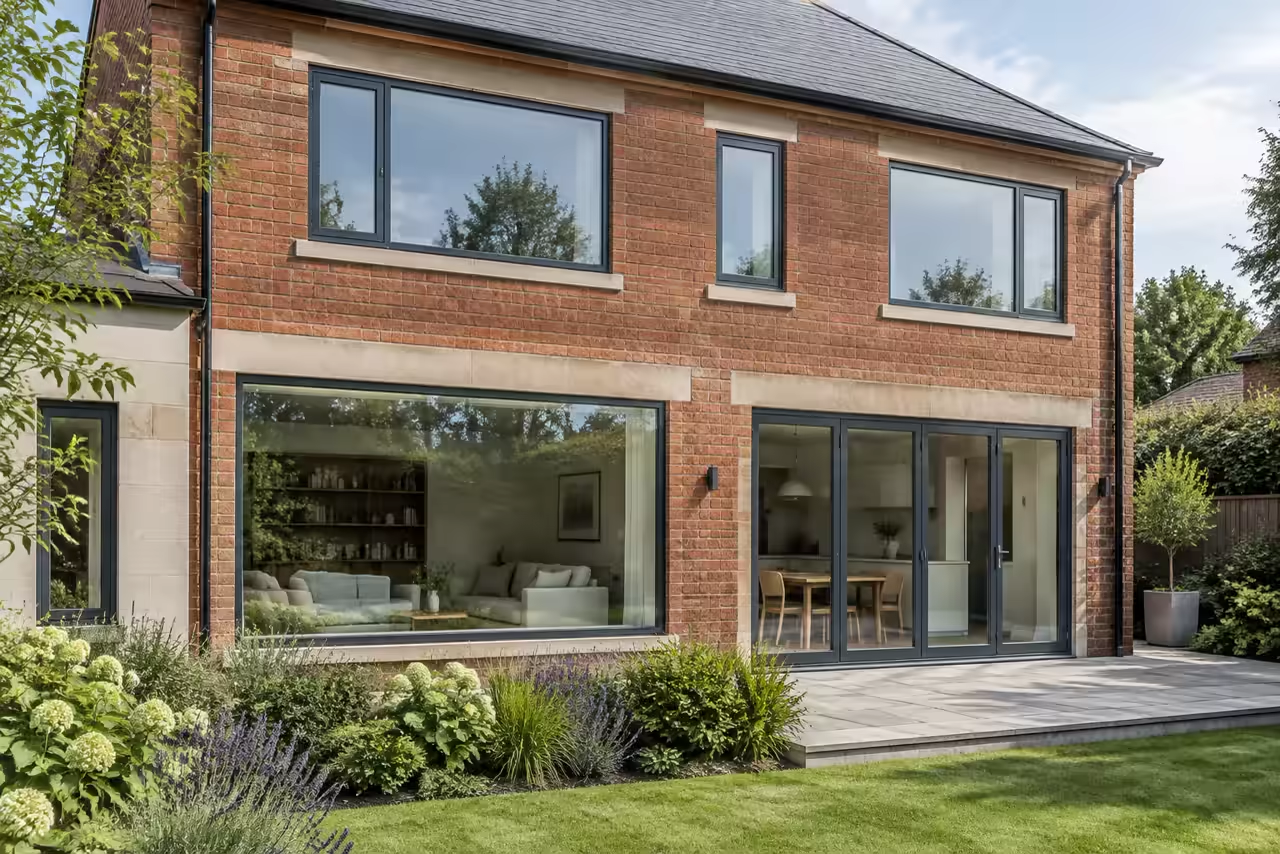
Comparison
Aluclad vs uPVC windows
Short answer
Aluclad is a real step up from uPVC: timber inside, aluminium outside, and usually a more premium feel and hardware. uPVC is far cheaper and perfectly good for many homes. The step up is worth it if you want timber inside or plan to stay a long time. It is rarely worth it for a quick resale.
Planning this? Get a free, no-obligation installer recommendation
Comparing aluclad against uPVC is rarely about basic weatherproofing — both keep UK rain out and meet building-regulation thermal limits — it is about whether real internal timber joinery and architectural hardware justify a markedly higher budget and longer lead time on your home.
What the extra spend actually buys
- Natural or factory-painted timber inside every room instead of plastic profiles
- A rigid aluminium outer skin that never needs exterior repainting
powder-coated
powder coating: Powder coating is a finish made by applying coating powder to a prepared metal surface and curing it to form a protective coloured layer. The quality of preparation and the specified coating system matter. A colour name alone does not establish suitability for coastal exposure, strong sunlight or a particular maintenance routine. More on powder coating - Substantial Nordic or European ironmongery designed for smooth, long-term daily operation
- Factory-finished large openings without visible welded corner seams
When staying with uPVC is the smarter call
If you plan to sell within a few years, are refurbishing a rental property, or want crisp white frames across modest openings, modern flush or chamfered uPVC delivers almost the same everyday warmth for far less outlay. Spending part of the saved budget on careful airtight perimeter taping, acoustic glass or better plaster making-good often improves comfort more than upgrading frame material alone.
Practical trade-offs to weigh before stretching
Aluclad is typically made to order with longer factory delivery windows and needs fitters familiar with its fixing straps and drainage details. On a tight renovation schedule, mixing aluclad in the main living spaces with colour-matched uPVC in utility or upstairs rooms is only worth doing if you check both exterior samples together outdoors first.
Side by side
| Compared | Aluclad windows | uPVC windows |
|---|---|---|
| Look and sightlines | Warm timber inside, aluminium outside. Clean modern lines; Nordic ranges often have a uniform look across opening and fixed panes. | Wider frames than aluminium. Timber-look and flush-sashsash: A sash is the framed part of a window that holds the glass; it often describes the moving part. In a sliding sash window, glazed sashes move vertically. The word alone does not identify the material, balance mechanism or cleaning action, so ask what the complete window description actually means. More on sash |
| Maximum sizes | Varies by range and opening type — ask for the manufacturer's maximum sashsash: A sash is the framed part of a window that holds the glass; it often describes the moving part. In a sliding sash window, glazed sashes move vertically. The word alone does not identify the material, balance mechanism or cleaning action, so ask what the complete window description actually means. More on sash | Varies by profile and reinforcement — usually more limited than aluminium for large panes; check the maker's size chart. |
| Thermal performance | Must meet building regulations. England, replacement windows: maximum U-valueU-value: A U-value describes how readily heat passes through a building element. A lower value means less heat loss through that element. For windows and doors, distinguish the complete assembly from the glass alone: a good glass figure does not establish the performance of the frame, edges and finished product. More on U-valueWindow Energy RatingWindow Energy Rating: A Window Energy Rating is a label assessing a window as a complete product, taking account of heat loss, solar gain and air leakage. It is not the same measurement as a glass U-value. Compare labels for the proposed window configuration and consider the room orientation alongside the rating. More on Window Energy RatingU-valueU-value: A U-value describes how readily heat passes through a building element. A lower value means less heat loss through that element. For windows and doors, distinguish the complete assembly from the glass alone: a good glass figure does not establish the performance of the frame, edges and finished product. More on U-valueU-valueU-value: A U-value describes how readily heat passes through a building element. A lower value means less heat loss through that element. For windows and doors, distinguish the complete assembly from the glass alone: a good glass figure does not establish the performance of the frame, edges and finished product. More on U-value | Must meet building regulations. England, replacement windows: maximum U-valueU-value: A U-value describes how readily heat passes through a building element. A lower value means less heat loss through that element. For windows and doors, distinguish the complete assembly from the glass alone: a good glass figure does not establish the performance of the frame, edges and finished product. More on U-valueWindow Energy RatingWindow Energy Rating: A Window Energy Rating is a label assessing a window as a complete product, taking account of heat loss, solar gain and air leakage. It is not the same measurement as a glass U-value. Compare labels for the proposed window configuration and consider the room orientation alongside the rating. More on Window Energy RatingU-valueU-value: A U-value describes how readily heat passes through a building element. A lower value means less heat loss through that element. For windows and doors, distinguish the complete assembly from the glass alone: a good glass figure does not establish the performance of the frame, edges and finished product. More on U-valueU-valueU-value: A U-value describes how readily heat passes through a building element. A lower value means less heat loss through that element. For windows and doors, distinguish the complete assembly from the glass alone: a good glass figure does not establish the performance of the frame, edges and finished product. More on U-value |
| Security standard | Confirm PAS 24PAS 24: PAS 24 is a security test specification for complete windows and external door sets. It examines resistance to defined attack methods rather than promising that a product cannot be broken into. Evidence should relate to the actual system, configuration and hardware, not merely a lock or a broad product range. More on PAS 24Secured by DesignSecured by Design: Secured by Design is a police security initiative that includes an approval scheme for products such as windows and doors. It is not a general guarantee against crime. Check the current listing for the proposed product and distinguish product approval from wider recommendations about the design of a building. More on Secured by Design | Ask for PAS 24PAS 24: PAS 24 is a security test specification for complete windows and external door sets. It examines resistance to defined attack methods rather than promising that a product cannot be broken into. Evidence should relate to the actual system, configuration and hardware, not merely a lock or a broad product range. More on PAS 24 |
| Ease of use | Usually very smooth hardware; many Nordic ranges open outwards. | Straightforward; hardware quality varies. |
| Maintenance | Aluminium outside needs little care; the timber inside is treated like good joinery. | Wipe clean. Foiled timber-look finishes need gentle cleaning. |
| Expected lifespan | VELFAC reports independent testing for a 40+ year lifespan with a 12-year warranty on VELFAC 200 windows; DOVISTA UK covers Rationel AURAPLUS/FORMAPLUS and VELFAC Ribo/Classic aluclad windows for 10 years. | UK uPVC profile makers such as Eurocell publish a minimum 10-year guarantee on window profiles; hardware and sealed-unit warranties are typically shorter — confirm all three periods in writing. |
| Typical price band | Timber-aluminium (aluclad) windows: £1,200 to £3,000 per window, average £1,800 (Checkatrade composite windows cost guide, last updated Aug 2026; checked 25 Nov 2026) (typical published UK range, supplied and fitted). | Casementcasement: A casement is a hinged window opening, usually attached at the side or top of its frame. It opens rather than sliding vertically like a traditional sliding sash. The hinge position and opening direction affect ventilation, cleaning, clear passage and conflicts with paths, taps, curtains or furniture. More on casementcasementcasement: A casement is a hinged window opening, usually attached at the side or top of its frame. It opens rather than sliding vertically like a traditional sliding sash. The hinge position and opening direction affect ventilation, cleaning, clear passage and conflicts with paths, taps, curtains or furniture. More on casementcasementscasement: A casement is a hinged window opening, usually attached at the side or top of its frame. It opens rather than sliding vertically like a traditional sliding sash. The hinge position and opening direction affect ventilation, cleaning, clear passage and conflicts with paths, taps, curtains or furniture. More on casement |
| Best for | Homes where you want timber inside without painting timber outside, and exposed sites. | Value for money on standard-sized windows, and timber-look styles on traditional homes. |
| Watch-outs | Outward-opening styles need thinking about for cleaning and escape. Longer lead times are common. | Bulkier frames on big openings. Coloured foilsfoil (woodgrain): A woodgrain foil is a decorative surface layer bonded to a profile, commonly used on uPVC windows and doors to imitate painted or stained timber. It describes the finish, not the frame material. Texture, colour, corner joints and matching trims all affect how convincing the result looks on a real building. More on foil (woodgrain) |
Figures from published manufacturer data, building regulations and UK cost guides. Your price will depend on your project.
Prices are published guide figures from the sources listed, not our own quotes. Installed prices vary by UK region, access, glazing specification and making good.
- Pilkington UK — Part L England existing dwellings guidance (Part L 2021 (in force June 2022)) — checked
- REHAU — Part L existing dwellings fact sheet (PDF) (2022 edition) — checked
- British Woodworking Federation — Part L new dwellings summary (2022 Part L update) — checked
- Pilkington UK — Scottish Building Standards Section 6 domestic guidance (2022/2023 Scottish Technical Handbook) — checked
- VELFAC — Windows and doors warranty page (undated manufacturer warranty page) — checked
- DOVISTA UK (VELFAC & Rationel) — Warranty Terms (PDF) (dated 27 Feb 2026) — checked
- Checkatrade — Composite & aluclad windows cost guide (last updated Aug 2026) — checked
- Eurocell — uPVC & aluminium windows guarantee (undated manufacturer page) — checked
- Homebuilding & Renovating — New window costs (last updated 23 Apr 2025) — checked
- Checkatrade — New windows cost guide (last updated Jul 2026; table figures listed as +VAT (excl. VAT)) — checked
Choose aluclad windows if…
- you want timber inside
- you are staying long term
- the house suits a Nordic or rural look
Choose upvc windows if…
- budget is the priority
- you want white or timber-look
- you may move within a few years
Three real scenarios
Forever home renovation
Aluclad is worth pricing. You will live with the windows for decades.
Buy-to-let flat
uPVC. Durable, low maintenance and cost-effective.
Mixed budget
Aluclad in the main living rooms, uPVC in the utility and bathrooms, if the exterior colours match well.
The team's verdict
If you want timber inside and are staying put, aluclad is worth the stretch. If not, put the money into a good uPVC range and a careful fit, which will make more difference than the material.
Questions people also ask
Is aluclad more energy efficient?
Not automatically. Compare the whole-window for each exact product and glass unit.
U-value
U-value: A U-value describes how readily heat passes through a building element. A lower value means less heat loss through that element. For windows and doors, distinguish the complete assembly from the glass alone: a good glass figure does not establish the performance of the frame, edges and finished product. More on U-valueDoes aluclad add value to a house?
It can appeal to buyers, but we cannot give a figure.
Can aluclad be mixed with uPVC?
Yes, but match exterior colours and profiles carefully.
Is aluclad harder to fit?
It needs an installer who knows the system. Ask about their experience.
Last reviewed:
Answered by the Windows & Doors Answered team. How we write answers · Corrections policy
Related
Ask a free question
Didn't find your answer? Ask the team. The team usually replies within one working day.