Comparison
Aluminium vs uPVC windows
Short answer
Aluminium is worth the extra where frame width shows: large windows, modern designs and strong colours. uPVC is honest value for standard-sized windows, especially in white or timber-look finishes. Many homes mix both sensibly, using aluminium for the big feature glazing and uPVC elsewhere, as long as colours and styles are matched.
Planning this? Get a free, no-obligation installer recommendation
This is general information, not planning, building-regulations or legal advice. Rules depend on the property, the work and the nation you live in. Confirm your own project with your local council or building control body before ordering.
Aluminium earns its higher price where frame width is obvious — large picture windows, multi-pane extension elevations and bold colours — whereas uPVC delivers stronger value on modest, standard-sized house windows. Our three-way comparison brings aluclad into the picture; this page focuses on whether stepping up from uPVC to aluminium actually pays off window by window.
RAL
RAL: RAL is a colour reference system used to specify finishes, including many coated aluminium windows and doors. A reference identifies a colour target, not a guarantee that different materials or finishes will look identical. Surface texture, gloss, lighting and the coating process can alter how the chosen shade appears. More on RALWhere aluminium's slimmer frame actually shows
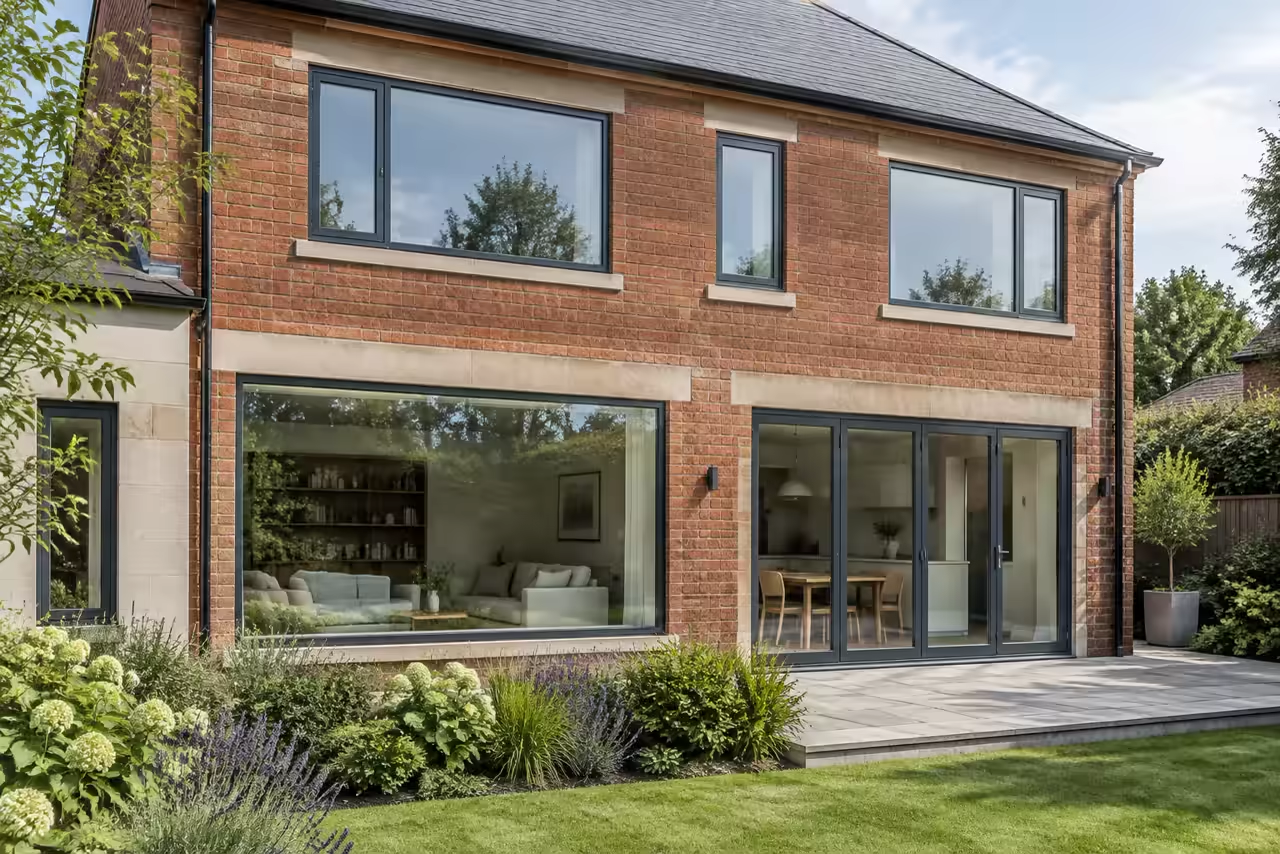
On a compact upstairs landing or bathroom window, the visual gap between a neat flush uPVC and an aluminium frame is modest. Put both across a four-metre kitchen run or tall stairwell glazing, however, and aluminium's slimmer and stiffer leave noticeably more daylight and fewer bulky meeting stiles.
casement
casement: A casement is a hinged window opening, usually attached at the side or top of its frame. It opens rather than sliding vertically like a traditional sliding sash. The hinge position and opening direction affect ventilation, cleaning, clear passage and conflicts with paths, taps, curtains or furniture. More on casementsightlines
sightline: A sightline is the visible width of frame you see when you look at a window or door. Slimmer sightlines mean more glass and less frame. Makers sometimes measure it differently, so compare drawings of the exact products, especially where fixed and opening panes sit side by side. More on sightlinemullions
mullion: A mullion is a vertical dividing member within a window or glazed screen. It separates adjacent lights or sections and may provide structural support as part of the assembly. It is different from a decorative glazing bar. Its position and width affect the view, visible glass and arrangement of opening parts. More on mullionPowder-coated colour vs foiled uPVC
Aluminium is factory in almost any shade, with frames (for instance dark grey outside, white inside) routine. uPVC relies on bonded coloured or sprayed coatings: popular shades like anthracite grey, agate grey and cream are widely stocked, yet bespoke colours cost more and dark expand more in direct sun than aluminium.
powder-coated
powder coating: Powder coating is a finish made by applying coating powder to a prepared metal surface and curing it to form a protective coloured layer. The quality of preparation and the specified coating system matter. A colour name alone does not establish suitability for coastal exposure, strong sunlight or a particular maintenance routine. More on powder coatingRAL
RAL: RAL is a colour reference system used to specify finishes, including many coated aluminium windows and doors. A reference identifies a colour target, not a guarantee that different materials or finishes will look identical. Surface texture, gloss, lighting and the coating process can alter how the chosen shade appears. More on RALdual-colour
dual colour: Dual colour means that a window or door has different finishes on its outside and inside faces. It may be achieved through coatings, foils or separate components, depending on the material and system. Check what is visible at edges and when the sash or door is open, not only when closed. More on dual colourfoils
foil (woodgrain): A woodgrain foil is a decorative surface layer bonded to a profile, commonly used on uPVC windows and doors to imitate painted or stained timber. It describes the finish, not the frame material. Texture, colour, corner joints and matching trims all affect how convincing the result looks on a real building. More on foil (woodgrain)foils
foil (woodgrain): A woodgrain foil is a decorative surface layer bonded to a profile, commonly used on uPVC windows and doors to imitate painted or stained timber. It describes the finish, not the frame material. Texture, colour, corner joints and matching trims all affect how convincing the result looks on a real building. More on foil (woodgrain)powder-coated
powder coating: Powder coating is a finish made by applying coating powder to a prepared metal surface and curing it to form a protective coloured layer. The quality of preparation and the specified coating system matter. A colour name alone does not establish suitability for coastal exposure, strong sunlight or a particular maintenance routine. More on powder coatingMixing both materials on one house
Fitting aluminium on a new rear extension while replacing tired front and upstairs windows in uPVC is a practical way to protect your budget. The trap is assuming identical codes look identical across two materials: a smooth matt reflects daylight differently from a grained uPVC , so hold both physical samples outdoors against the brickwork before ordering.
RAL
RAL: RAL is a colour reference system used to specify finishes, including many coated aluminium windows and doors. A reference identifies a colour target, not a guarantee that different materials or finishes will look identical. Surface texture, gloss, lighting and the coating process can alter how the chosen shade appears. More on RALpowder coat
powder coating: Powder coating is a finish made by applying coating powder to a prepared metal surface and curing it to form a protective coloured layer. The quality of preparation and the specified coating system matter. A colour name alone does not establish suitability for coastal exposure, strong sunlight or a particular maintenance routine. More on powder coatingfoil
foil (woodgrain): A woodgrain foil is a decorative surface layer bonded to a profile, commonly used on uPVC windows and doors to imitate painted or stained timber. It describes the finish, not the frame material. Texture, colour, corner joints and matching trims all affect how convincing the result looks on a real building. More on foil (woodgrain)On a period or protected house
Original window type matters more than brochure labels on older houses. Slim aluminium can echo 1930s metal , while mechanically jointed flush uPVC is sometimes considered on undesignated cottages where timber sat originally. Neither material carries automatic acceptance on listed buildings or restricted conservation elevations — verify local planning controls in England or Scotland and price joinery repair first.
casements
casement: A casement is a hinged window opening, usually attached at the side or top of its frame. It opens rather than sliding vertically like a traditional sliding sash. The hinge position and opening direction affect ventilation, cleaning, clear passage and conflicts with paths, taps, curtains or furniture. More on casementcasements
casement: A casement is a hinged window opening, usually attached at the side or top of its frame. It opens rather than sliding vertically like a traditional sliding sash. The hinge position and opening direction affect ventilation, cleaning, clear passage and conflicts with paths, taps, curtains or furniture. More on casementRelated pages on this topic
Side by side
| Compared | Aluminium windows | uPVC windows |
|---|---|---|
| Look and sightlines | Slim, crisp frames. Suits modern homes and large glazed areas; flush styles suit some traditional homes too. | Wider frames than aluminium. Timber-look and flush-sashsash: A sash is the framed part of a window that holds the glass; it often describes the moving part. In a sliding sash window, glazed sashes move vertically. The word alone does not identify the material, balance mechanism or cleaning action, so ask what the complete window description actually means. More on sash |
| Maximum sizes | Varies by profile — aluminium generally allows larger panes than uPVC for the same sightlinesightline: A sightline is the visible width of frame you see when you look at a window or door. Slimmer sightlines mean more glass and less frame. Makers sometimes measure it differently, so compare drawings of the exact products, especially where fixed and opening panes sit side by side. More on sightline | Varies by profile and reinforcement — usually more limited than aluminium for large panes; check the maker's size chart. |
| Thermal performance | Must meet building regulations. England, replacement windows: maximum U-valueU-value: A U-value describes how readily heat passes through a building element. A lower value means less heat loss through that element. For windows and doors, distinguish the complete assembly from the glass alone: a good glass figure does not establish the performance of the frame, edges and finished product. More on U-valueWindow Energy RatingWindow Energy Rating: A Window Energy Rating is a label assessing a window as a complete product, taking account of heat loss, solar gain and air leakage. It is not the same measurement as a glass U-value. Compare labels for the proposed window configuration and consider the room orientation alongside the rating. More on Window Energy RatingU-valueU-value: A U-value describes how readily heat passes through a building element. A lower value means less heat loss through that element. For windows and doors, distinguish the complete assembly from the glass alone: a good glass figure does not establish the performance of the frame, edges and finished product. More on U-valueU-valueU-value: A U-value describes how readily heat passes through a building element. A lower value means less heat loss through that element. For windows and doors, distinguish the complete assembly from the glass alone: a good glass figure does not establish the performance of the frame, edges and finished product. More on U-value | Must meet building regulations. England, replacement windows: maximum U-valueU-value: A U-value describes how readily heat passes through a building element. A lower value means less heat loss through that element. For windows and doors, distinguish the complete assembly from the glass alone: a good glass figure does not establish the performance of the frame, edges and finished product. More on U-valueWindow Energy RatingWindow Energy Rating: A Window Energy Rating is a label assessing a window as a complete product, taking account of heat loss, solar gain and air leakage. It is not the same measurement as a glass U-value. Compare labels for the proposed window configuration and consider the room orientation alongside the rating. More on Window Energy RatingU-valueU-value: A U-value describes how readily heat passes through a building element. A lower value means less heat loss through that element. For windows and doors, distinguish the complete assembly from the glass alone: a good glass figure does not establish the performance of the frame, edges and finished product. More on U-valueU-valueU-value: A U-value describes how readily heat passes through a building element. A lower value means less heat loss through that element. For windows and doors, distinguish the complete assembly from the glass alone: a good glass figure does not establish the performance of the frame, edges and finished product. More on U-value |
| Security standard | Ask for PAS 24PAS 24: PAS 24 is a security test specification for complete windows and external door sets. It examines resistance to defined attack methods rather than promising that a product cannot be broken into. Evidence should relate to the actual system, configuration and hardware, not merely a lock or a broad product range. More on PAS 24laminated glasslaminated glass: Laminated glass has glass layers bonded around an interlayer that can hold broken pieces together. Depending on its specification, it may serve safety, security or acoustic purposes. Those functions are not automatic: the glass build-up, supporting frame and tested application decide what protection the complete assembly can provide. More on laminated glass | Ask for PAS 24PAS 24: PAS 24 is a security test specification for complete windows and external door sets. It examines resistance to defined attack methods rather than promising that a product cannot be broken into. Evidence should relate to the actual system, configuration and hardware, not merely a lock or a broad product range. More on PAS 24 |
| Ease of use | Smooth operation; hardware quality varies between systems. | Straightforward; hardware quality varies. |
| Maintenance | Powder coatpowder coating: Powder coating is a finish made by applying coating powder to a prepared metal surface and curing it to form a protective coloured layer. The quality of preparation and the specified coating system matter. A colour name alone does not establish suitability for coastal exposure, strong sunlight or a particular maintenance routine. More on powder coating | Wipe clean. Foiled timber-look finishes need gentle cleaning. |
| Expected lifespan | Published UK aluminium window guarantees start from 10 years (Eurocell minimum 10-year guarantee) up to 20 years (Origin Global, depending on location); marine-grade powder-coat terms differ near the coast. | UK uPVC profile makers such as Eurocell publish a minimum 10-year guarantee on window profiles; hardware and sealed-unit warranties are typically shorter — confirm all three periods in writing. |
| Typical price band | Per window: casementcasement: A casement is a hinged window opening, usually attached at the side or top of its frame. It opens rather than sliding vertically like a traditional sliding sash. The hinge position and opening direction affect ventilation, cleaning, clear passage and conflicts with paths, taps, curtains or furniture. More on casementcasementcasement: A casement is a hinged window opening, usually attached at the side or top of its frame. It opens rather than sliding vertically like a traditional sliding sash. The hinge position and opening direction affect ventilation, cleaning, clear passage and conflicts with paths, taps, curtains or furniture. More on casementtilt and turntilt-and-turn: A tilt-and-turn window uses hardware that lets its sash tilt inward for ventilation or turn inward on side hinges for a wider opening. The operating mode depends on the handle and mechanism. It needs clear space inside and a safe plan for cleaning, restricting access and any required escape provision. More on tilt-and-turnsashsash: A sash is the framed part of a window that holds the glass; it often describes the moving part. In a sliding sash window, glazed sashes move vertically. The word alone does not identify the material, balance mechanism or cleaning action, so ask what the complete window description actually means. More on sash | Casementcasement: A casement is a hinged window opening, usually attached at the side or top of its frame. It opens rather than sliding vertically like a traditional sliding sash. The hinge position and opening direction affect ventilation, cleaning, clear passage and conflicts with paths, taps, curtains or furniture. More on casementcasementcasement: A casement is a hinged window opening, usually attached at the side or top of its frame. It opens rather than sliding vertically like a traditional sliding sash. The hinge position and opening direction affect ventilation, cleaning, clear passage and conflicts with paths, taps, curtains or furniture. More on casementcasementscasement: A casement is a hinged window opening, usually attached at the side or top of its frame. It opens rather than sliding vertically like a traditional sliding sash. The hinge position and opening direction affect ventilation, cleaning, clear passage and conflicts with paths, taps, curtains or furniture. More on casement |
| Best for | Slim sightlinessightline: A sightline is the visible width of frame you see when you look at a window or door. Slimmer sightlines mean more glass and less frame. Makers sometimes measure it differently, so compare drawings of the exact products, especially where fixed and opening panes sit side by side. More on sightlineRALRAL: RAL is a colour reference system used to specify finishes, including many coated aluminium windows and doors. A reference identifies a colour target, not a guarantee that different materials or finishes will look identical. Surface texture, gloss, lighting and the coating process can alter how the chosen shade appears. More on RALdual colourdual colour: Dual colour means that a window or door has different finishes on its outside and inside faces. It may be achieved through coatings, foils or separate components, depending on the material and system. Check what is visible at edges and when the sash or door is open, not only when closed. More on dual colour | Value for money on standard-sized windows, and timber-look styles on traditional homes. |
| Watch-outs | Cheaper systems can have bulkier frames. Coastal sites need the right coating and aftercare. | Bulkier frames on big openings. Coloured foilsfoil (woodgrain): A woodgrain foil is a decorative surface layer bonded to a profile, commonly used on uPVC windows and doors to imitate painted or stained timber. It describes the finish, not the frame material. Texture, colour, corner joints and matching trims all affect how convincing the result looks on a real building. More on foil (woodgrain) |
Figures from published manufacturer data, building regulations and UK cost guides. Your price will depend on your project.
Prices are published guide figures from the sources listed, not our own quotes. Installed prices vary by UK region, access, glazing specification and making good.
- Pilkington UK — Part L England existing dwellings guidance (Part L 2021 (in force June 2022)) — checked
- REHAU — Part L existing dwellings fact sheet (PDF) (2022 edition) — checked
- British Woodworking Federation — Part L new dwellings summary (2022 Part L update) — checked
- Pilkington UK — Scottish Building Standards Section 6 domestic guidance (2022/2023 Scottish Technical Handbook) — checked
- Eurocell — uPVC & aluminium windows guarantee (undated manufacturer page) — checked
- Origin Global — Up to 20-year guarantee page (undated manufacturer guarantee page) — checked
- Homebuilding & Renovating — New window costs (last updated 23 Apr 2025) — checked
- Federation of Master Builders — Aluminium windows cost guide (undated UK guide; does not state whether fitting or VAT is included) — checked
- Checkatrade — New windows cost guide (last updated Jul 2026; table figures listed as +VAT (excl. VAT)) — checked
Choose aluminium windows if…
- your windows are large, or there are lots of them in one elevation
- you want a strong or
dual colour
dual colour: Dual colour means that a window or door has different finishes on its outside and inside faces. It may be achieved through coatings, foils or separate components, depending on the material and system. Check what is visible at edges and when the sash or door is open, not only when closed. More on dual colour - you prefer a slim, modern look
Choose upvc windows if…
- your windows are standard sizes
- budget is the main driver
- you want white or a timber-look
foil
foil (woodgrain): A woodgrain foil is a decorative surface layer bonded to a profile, commonly used on uPVC windows and doors to imitate painted or stained timber. It describes the finish, not the frame material. Texture, colour, corner joints and matching trims all affect how convincing the result looks on a real building. More on foil (woodgrain)
Three real scenarios
Whole-house replacement on a 1980s estate home
uPVC in a good flush or chamfered profile is usually right. The windows are modest, and the saving can go towards better fitting and glass.
Single-storey rear extension with a long run of glazing
Aluminium for the extension. The frames on a long run are what you see from the kitchen, and slim ones make the room feel lighter.
Coastal bungalow
Either can work. Ask about the coating or guarantee for coastal sites, and how often frames should be washed to keep it valid.
foil
foil (woodgrain): A woodgrain foil is a decorative surface layer bonded to a profile, commonly used on uPVC windows and doors to imitate painted or stained timber. It describes the finish, not the frame material. Texture, colour, corner joints and matching trims all affect how convincing the result looks on a real building. More on foil (woodgrain)The team's verdict
Spend on aluminium where it shows: big glass, modern designs and colour. For ordinary-sized windows, a good uPVC range is better value, and the difference in daily life is small. Do not be talked into aluminium throughout if most of your windows are small.
Questions people also ask
Is aluminium more secure than uPVC?
Not by material alone. Check certification for the exact product you are buying.
PAS 24
PAS 24: PAS 24 is a security test specification for complete windows and external door sets. It examines resistance to defined attack methods rather than promising that a product cannot be broken into. Evidence should relate to the actual system, configuration and hardware, not merely a lock or a broad product range. More on PAS 24Do aluminium windows suffer from condensation?
Modern frames are far better than old aluminium. Condensation is mainly about room ventilation.
thermally broken
thermal break: A thermal break is a less conductive connection separating the inner and outer parts of a metal frame to reduce heat flow through it. It helps improve frame performance but does not determine the whole window result alone. Glass, spacers, geometry and the installation junction all remain part of the assessment. More on thermal breakCan I mix aluminium and uPVC on one house?
Yes, many people do. Match colours with physical samples, as finishes vary.
Which lasts longer?
Both last well when made and fitted properly. Check the written frame, finish, glass and hardware warranties on each quote.
Last reviewed:
Answered by the Windows & Doors Answered team. How we write answers · Corrections policy
Related
Ask a free question
Didn't find your answer? Ask the team. The team usually replies within one working day.