Comparison
Aluminium vs composite front doors
Short answer
Choose a composite front door for traditional and cottage styles at a sensible price, with a finish and a solid feel. Choose aluminium for modern flush designs, larger doors and any colour. Both can be very secure. Check the certification for the exact door, not the brand.
woodgrain
foil (woodgrain): A woodgrain foil is a decorative surface layer bonded to a profile, commonly used on uPVC windows and doors to imitate painted or stained timber. It describes the finish, not the frame material. Texture, colour, corner joints and matching trims all affect how convincing the result looks on a real building. More on foil (woodgrain)Planning this? Get a free, no-obligation installer recommendation
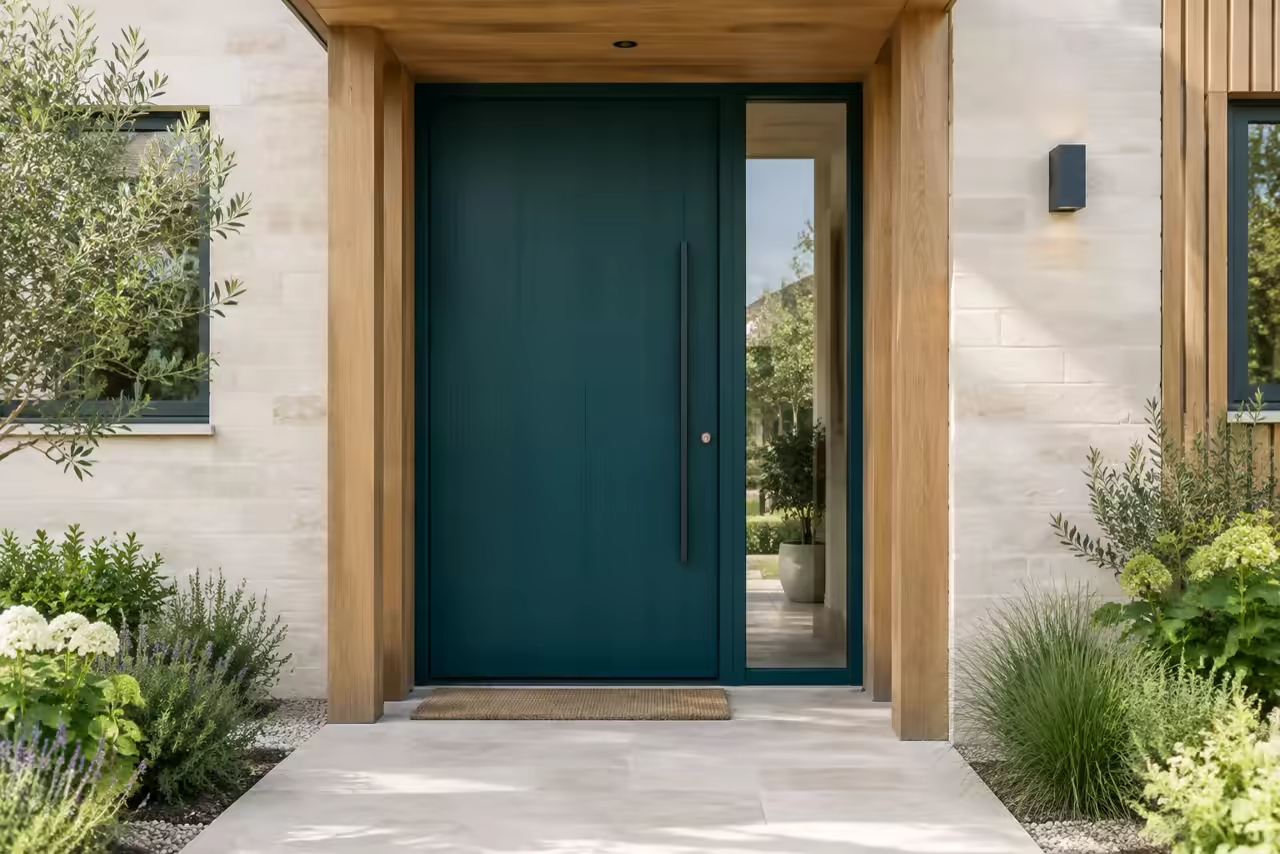
Composite front doors suit traditional UK terraced, cottage and semi-detached houses with moulded panel styles and skins at a moderate price, whereas aluminium entrance doors suit contemporary architecture, oversized doorways and flush architectural finishes where stability in direct sun matters.
woodgrain
foil (woodgrain): A woodgrain foil is a decorative surface layer bonded to a profile, commonly used on uPVC windows and doors to imitate painted or stained timber. It describes the finish, not the frame material. Texture, colour, corner joints and matching trims all affect how convincing the result looks on a real building. More on foil (woodgrain)thermally broken
thermal break: A thermal break is a less conductive connection separating the inner and outer parts of a metal frame to reduce heat flow through it. It helps improve frame performance but does not determine the whole window result alone. Glass, spacers, geometry and the installation junction all remain part of the assessment. More on thermal breakConstruction, feel and design range
Most composite doors combine a glass-reinforced plastic (GRP) outer skin with either a high-density foam or solid laminated timber core inside a uPVC or aluminium outer frame. Aluminium front doors use insulated aluminium panels set flush into a rigid aluminium frame — offering minimalist concealed hinges, recessed pulls, oversized leaf widths and exact matching to aluminium windows.
powder-coated
powder coating: Powder coating is a finish made by applying coating powder to a prepared metal surface and curing it to form a protective coloured layer. The quality of preparation and the specified coating system matter. A colour name alone does not establish suitability for coastal exposure, strong sunlight or a particular maintenance routine. More on powder coatingRAL
RAL: RAL is a colour reference system used to specify finishes, including many coated aluminium windows and doors. A reference identifies a colour target, not a guarantee that different materials or finishes will look identical. Surface texture, gloss, lighting and the coating process can alter how the chosen shade appears. More on RALDark colours on south- and west-facing entrances
Dark black, navy or anthracite GRP skins baking in unshaded afternoon sun can bow slightly over time if the core and frame are not engineered for thermal movement, causing stiff multi-point hooks. Insulated aluminium entrance doors generally tolerate solar heat and tall leaf heights more calmly, though you should still check the maker's dark-colour warranty on exposed south-facing porches.
Security depends on the tested doorset, not the material
Both composite and aluminium front doors can achieve and status — and poorly specified versions of either can fall short. Verify third-party test evidence for the complete door, frame, cassette and 3-star anti-snap cylinder rather than trusting a brochure headline.
PAS 24
PAS 24: PAS 24 is a security test specification for complete windows and external door sets. It examines resistance to defined attack methods rather than promising that a product cannot be broken into. Evidence should relate to the actual system, configuration and hardware, not merely a lock or a broad product range. More on PAS 24Secured by Design
Secured by Design: Secured by Design is a police security initiative that includes an approval scheme for products such as windows and doors. It is not a general guarantee against crime. Check the current listing for the proposed product and distinguish product approval from wider recommendations about the design of a building. More on Secured by Designlaminated glass
laminated glass: Laminated glass has glass layers bonded around an interlayer that can hold broken pieces together. Depending on its specification, it may serve safety, security or acoustic purposes. Those functions are not automatic: the glass build-up, supporting frame and tested application decide what protection the complete assembly can provide. More on laminated glassRelated pages on this topic
Side by side
| Compared | Aluminium front doors | Composite front doors |
|---|---|---|
| Look and sightlines | Flush, contemporary slabs with long bar handles; any colour inside and out. | Moulded skins in traditional and modern styles, often with woodgrainfoil (woodgrain): A woodgrain foil is a decorative surface layer bonded to a profile, commonly used on uPVC windows and doors to imitate painted or stained timber. It describes the finish, not the frame material. Texture, colour, corner joints and matching trims all affect how convincing the result looks on a real building. More on foil (woodgrain) |
| Maximum sizes | Maximum widths and heights for Aluminium front doors depend on wind load and glass weight — confirm against the maker's size chart. | Maximum widths and heights for Composite front doors depend on wind load and glass weight — confirm against the maker's size chart. |
| Thermal performance | Must meet building regulations. England, replacement doors (60% glazed or less): maximum 1.4 W/m²K or band B. England, new homes: limiting 1.6 W/m²K (notional 1.0). Scotland: maximum 1.4 W/m²K. | Must meet building regulations. England, replacement doors (60% glazed or less): maximum 1.4 W/m²K or band B. England, new homes: limiting 1.6 W/m²K (notional 1.0). Scotland: maximum 1.4 W/m²K. |
| Security standard | Verify PAS 24PAS 24: PAS 24 is a security test specification for complete windows and external door sets. It examines resistance to defined attack methods rather than promising that a product cannot be broken into. Evidence should relate to the actual system, configuration and hardware, not merely a lock or a broad product range. More on PAS 24Secured by DesignSecured by Design: Secured by Design is a police security initiative that includes an approval scheme for products such as windows and doors. It is not a general guarantee against crime. Check the current listing for the proposed product and distinguish product approval from wider recommendations about the design of a building. More on Secured by Design | Verify PAS 24PAS 24: PAS 24 is a security test specification for complete windows and external door sets. It examines resistance to defined attack methods rather than promising that a product cannot be broken into. Evidence should relate to the actual system, configuration and hardware, not merely a lock or a broad product range. More on PAS 24Secured by DesignSecured by Design: Secured by Design is a police security initiative that includes an approval scheme for products such as windows and doors. It is not a general guarantee against crime. Check the current listing for the proposed product and distinguish product approval from wider recommendations about the design of a building. More on Secured by Design |
| Ease of use | Stays true; feels solid and quiet. | Solid feel; good weather sealing. |
| Maintenance | Very low; an occasional wash. | Low; dark colours on sunny elevations need checking with the maker. |
| Expected lifespan | Published UK aluminium door guarantees include up to 20 years on Origin products (location-dependent); confirm powder-coat and hardware terms separately. | Rockdoor and Solidor both publish 10-year composite door guarantees (Rockdoor: 10 years on sashsash: A sash is the framed part of a window that holds the glass; it often describes the moving part. In a sliding sash window, glazed sashes move vertically. The word alone does not identify the material, balance mechanism or cleaning action, so ask what the complete window description actually means. More on sash |
| Typical price band | Front doors and frames overall: £500 to £3,000, average £1,750 (Checkatrade new door frame guide, last updated Sep 2026); higher-end or bespoke front doors can exceed £2,000 (MyBuilder front door guide, last updated 21 Aug 2026; checked 25 Nov 2026) (typical published UK range, supplied and fitted). | New front doors: typically £1,000 to £2,000, averaging around £1,500, with bespoke designs above £2,000 (MyBuilder front door guide, last updated 21 Aug 2026; checked 25 Nov 2026) (typical published UK range, supplied and fitted). |
| Best for | Modern homes and statement entrances, including wide or tall doors. | Traditional and cottage-style front doors on a sensible budget. |
| Watch-outs | Fewer traditional styles than composite. | Quality varies widely; dark doors in full sun can move slightly. |
Figures from published manufacturer data, building regulations and UK cost guides. Your price will depend on your project.
Prices are published guide figures from the sources listed, not our own quotes. Installed prices vary by UK region, access, glazing specification and making good.
- Pilkington UK — Part L England existing dwellings guidance (Part L 2021 (in force June 2022)) — checked
- REHAU — Part L existing dwellings fact sheet (PDF) (2022 edition) — checked
- British Woodworking Federation — Part L new dwellings summary (2022 Part L update) — checked
- Pilkington UK — Scottish Building Standards Section 6 domestic guidance (2022/2023 Scottish Technical Handbook) — checked
- Origin Global — Up to 20-year guarantee page (undated manufacturer guarantee page) — checked
- Checkatrade — New door and frame cost guide (last updated Sep 2026) — checked
- MyBuilder — New front door price guide (last updated 21 Aug 2026) — checked
- Rockdoor — Composite door guarantee terms (undated manufacturer guarantee page) — checked
- Solidor — Care and 10-year guarantee guide (PDF) (undated manufacturer guide) — checked
Choose aluminium front doors if…
- you want a modern flush door
- the door is wide or tall
- you want any colour, inside and out
Choose composite front doors if…
- you want a traditional panelled door
- budget is moderate
- you like a finish
woodgrain
foil (woodgrain): A woodgrain foil is a decorative surface layer bonded to a profile, commonly used on uPVC windows and doors to imitate painted or stained timber. It describes the finish, not the frame material. Texture, colour, corner joints and matching trims all affect how convincing the result looks on a real building. More on foil (woodgrain)
Three real scenarios
Victorian terrace
A composite door in a four-panel style suits most terraces well. Check the council's view if you are in a conservation area.
Contemporary new build with a wide entrance
Aluminium. Wide and tall flush doors are where it shines.
South-facing door in a dark colour
Ask both makers about heat. The safer choice depends on the exact product.
The team's verdict
For a traditional look at a fair price, a good composite door is hard to beat. For a modern entrance, especially a large one, choose aluminium. Either way, buy on certification and the lock, not on the brochure.
Questions people also ask
Which is more secure?
Neither by material alone. Check or for the exact door.
PAS 24
PAS 24: PAS 24 is a security test specification for complete windows and external door sets. It examines resistance to defined attack methods rather than promising that a product cannot be broken into. Evidence should relate to the actual system, configuration and hardware, not merely a lock or a broad product range. More on PAS 24Secured by Design
Secured by Design: Secured by Design is a police security initiative that includes an approval scheme for products such as windows and doors. It is not a general guarantee against crime. Check the current listing for the proposed product and distinguish product approval from wider recommendations about the design of a building. More on Secured by DesignDo composite doors warp?
Good ones are stable. Dark colours in full sun need checking with the maker.
Can I get side panels?
Yes, with both types.
Is an aluminium door cold?
Insulated aluminium doors are made to keep heat in. Ask your installer for the whole-door for the exact glass and core.
U-value
U-value: A U-value describes how readily heat passes through a building element. A lower value means less heat loss through that element. For windows and doors, distinguish the complete assembly from the glass alone: a good glass figure does not establish the performance of the frame, edges and finished product. More on U-valueWhat about a timber front door?
Timber suits listed and heritage homes. We will compare it on its own page.
Last reviewed:
Answered by the Windows & Doors Answered team. How we write answers · Corrections policy
Related
Ask a free question
Didn't find your answer? Ask the team. The team usually replies within one working day.