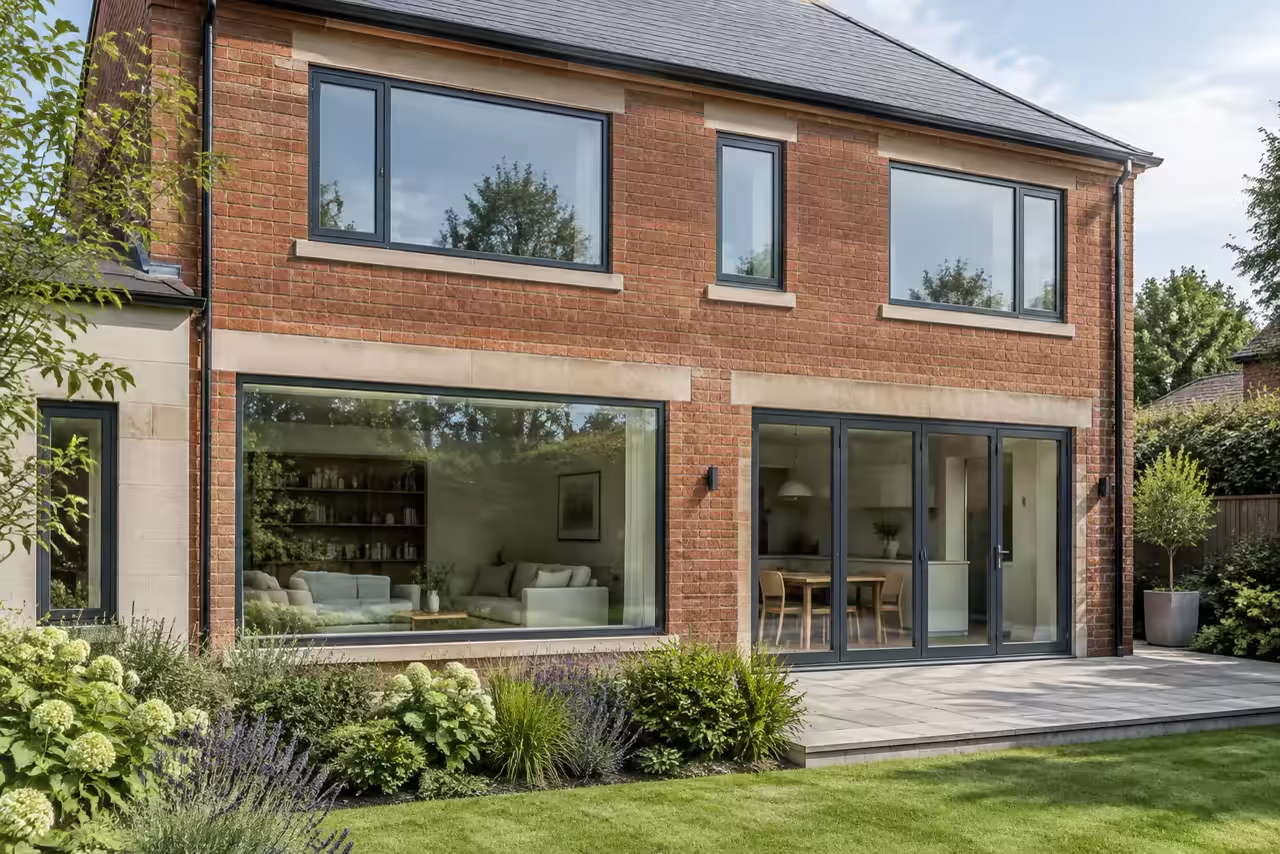
Comparison
Aluminium vs uPVC windows for a rental property
Short answer
For a rental property with ordinary-sized windows, a well-supported uPVC range is often the practical starting point. Aluminium can be worthwhile for large feature glazing or an existing aluminium scheme. Prioritise easy operation, replacement hardware and reliable maintenance access over a premium appearance; a lower purchase price is not the same as lower lifetime cost.
Planning this? Get a free, no-obligation installer recommendation
Aftercare changes the buying decision
Ask who will attend a dropped or failed lock, whether parts are identifiable and how glass can be replaced. A local service route and documented hardware can matter more to a landlord than small differences in visible frame width. Do not claim a lifespan saving without evidence.
sash
sash: A sash is the framed part of a window that holds the glass; it often describes the moving part. In a sliding sash window, glazed sashes move vertically. The word alone does not identify the material, balance mechanism or cleaning action, so ask what the complete window description actually means. More on sashSpecify for the actual occupants
Handles, restrictors, cleaning and ventilation should be straightforward to use. Explain the supplied operating instructions to tenants and keep them with the property records. A security claim for a profile does not establish certification for the finished window, and locks must not compromise required escape provision.
Compare the same scope
Get matching opening schedules, glass, finishes, disposal and making-good work. Published guide ranges are not a quote for this rental. Do not deduct a regional percentage to manufacture a project price. Protected buildings and applicable landlord duties need separate checks.
casement
casement: A casement is a hinged window opening, usually attached at the side or top of its frame. It opens rather than sliding vertically like a traditional sliding sash. The hinge position and opening direction affect ventilation, cleaning, clear passage and conflicts with paths, taps, curtains or furniture. More on casementSide by side
| Compared | Aluminium windows | uPVC windows |
|---|---|---|
| Look and sightlines | Slim, crisp frames. Suits modern homes and large glazed areas; flush styles suit some traditional homes too. | Wider frames than aluminium. Timber-look and flush-sashsash: A sash is the framed part of a window that holds the glass; it often describes the moving part. In a sliding sash window, glazed sashes move vertically. The word alone does not identify the material, balance mechanism or cleaning action, so ask what the complete window description actually means. More on sash |
| Maximum sizes | Varies by profile — aluminium generally allows larger panes than uPVC for the same sightlinesightline: A sightline is the visible width of frame you see when you look at a window or door. Slimmer sightlines mean more glass and less frame. Makers sometimes measure it differently, so compare drawings of the exact products, especially where fixed and opening panes sit side by side. More on sightline | Varies by profile and reinforcement — usually more limited than aluminium for large panes; check the maker's size chart. |
| Thermal performance | Must meet building regulations. England, replacement windows: maximum U-valueU-value: A U-value describes how readily heat passes through a building element. A lower value means less heat loss through that element. For windows and doors, distinguish the complete assembly from the glass alone: a good glass figure does not establish the performance of the frame, edges and finished product. More on U-valueWindow Energy RatingWindow Energy Rating: A Window Energy Rating is a label assessing a window as a complete product, taking account of heat loss, solar gain and air leakage. It is not the same measurement as a glass U-value. Compare labels for the proposed window configuration and consider the room orientation alongside the rating. More on Window Energy RatingU-valueU-value: A U-value describes how readily heat passes through a building element. A lower value means less heat loss through that element. For windows and doors, distinguish the complete assembly from the glass alone: a good glass figure does not establish the performance of the frame, edges and finished product. More on U-valueU-valueU-value: A U-value describes how readily heat passes through a building element. A lower value means less heat loss through that element. For windows and doors, distinguish the complete assembly from the glass alone: a good glass figure does not establish the performance of the frame, edges and finished product. More on U-value | Must meet building regulations. England, replacement windows: maximum U-valueU-value: A U-value describes how readily heat passes through a building element. A lower value means less heat loss through that element. For windows and doors, distinguish the complete assembly from the glass alone: a good glass figure does not establish the performance of the frame, edges and finished product. More on U-valueWindow Energy RatingWindow Energy Rating: A Window Energy Rating is a label assessing a window as a complete product, taking account of heat loss, solar gain and air leakage. It is not the same measurement as a glass U-value. Compare labels for the proposed window configuration and consider the room orientation alongside the rating. More on Window Energy RatingU-valueU-value: A U-value describes how readily heat passes through a building element. A lower value means less heat loss through that element. For windows and doors, distinguish the complete assembly from the glass alone: a good glass figure does not establish the performance of the frame, edges and finished product. More on U-valueU-valueU-value: A U-value describes how readily heat passes through a building element. A lower value means less heat loss through that element. For windows and doors, distinguish the complete assembly from the glass alone: a good glass figure does not establish the performance of the frame, edges and finished product. More on U-value |
| Security standard | Ask for PAS 24PAS 24: PAS 24 is a security test specification for complete windows and external door sets. It examines resistance to defined attack methods rather than promising that a product cannot be broken into. Evidence should relate to the actual system, configuration and hardware, not merely a lock or a broad product range. More on PAS 24laminated glasslaminated glass: Laminated glass has glass layers bonded around an interlayer that can hold broken pieces together. Depending on its specification, it may serve safety, security or acoustic purposes. Those functions are not automatic: the glass build-up, supporting frame and tested application decide what protection the complete assembly can provide. More on laminated glass | Ask for PAS 24PAS 24: PAS 24 is a security test specification for complete windows and external door sets. It examines resistance to defined attack methods rather than promising that a product cannot be broken into. Evidence should relate to the actual system, configuration and hardware, not merely a lock or a broad product range. More on PAS 24 |
| Ease of use | Smooth operation; hardware quality varies between systems. | Straightforward; hardware quality varies. |
| Maintenance | Powder coatpowder coating: Powder coating is a finish made by applying coating powder to a prepared metal surface and curing it to form a protective coloured layer. The quality of preparation and the specified coating system matter. A colour name alone does not establish suitability for coastal exposure, strong sunlight or a particular maintenance routine. More on powder coating | Wipe clean. Foiled timber-look finishes need gentle cleaning. |
| Expected lifespan | Published UK aluminium window guarantees start from 10 years (Eurocell minimum 10-year guarantee) up to 20 years (Origin Global, depending on location); marine-grade powder-coat terms differ near the coast. | UK uPVC profile makers such as Eurocell publish a minimum 10-year guarantee on window profiles; hardware and sealed-unit warranties are typically shorter — confirm all three periods in writing. |
| Typical price band | Per window: casementcasement: A casement is a hinged window opening, usually attached at the side or top of its frame. It opens rather than sliding vertically like a traditional sliding sash. The hinge position and opening direction affect ventilation, cleaning, clear passage and conflicts with paths, taps, curtains or furniture. More on casementcasementcasement: A casement is a hinged window opening, usually attached at the side or top of its frame. It opens rather than sliding vertically like a traditional sliding sash. The hinge position and opening direction affect ventilation, cleaning, clear passage and conflicts with paths, taps, curtains or furniture. More on casementtilt and turntilt-and-turn: A tilt-and-turn window uses hardware that lets its sash tilt inward for ventilation or turn inward on side hinges for a wider opening. The operating mode depends on the handle and mechanism. It needs clear space inside and a safe plan for cleaning, restricting access and any required escape provision. More on tilt-and-turnsashsash: A sash is the framed part of a window that holds the glass; it often describes the moving part. In a sliding sash window, glazed sashes move vertically. The word alone does not identify the material, balance mechanism or cleaning action, so ask what the complete window description actually means. More on sash | Casementcasement: A casement is a hinged window opening, usually attached at the side or top of its frame. It opens rather than sliding vertically like a traditional sliding sash. The hinge position and opening direction affect ventilation, cleaning, clear passage and conflicts with paths, taps, curtains or furniture. More on casementcasementcasement: A casement is a hinged window opening, usually attached at the side or top of its frame. It opens rather than sliding vertically like a traditional sliding sash. The hinge position and opening direction affect ventilation, cleaning, clear passage and conflicts with paths, taps, curtains or furniture. More on casementcasementscasement: A casement is a hinged window opening, usually attached at the side or top of its frame. It opens rather than sliding vertically like a traditional sliding sash. The hinge position and opening direction affect ventilation, cleaning, clear passage and conflicts with paths, taps, curtains or furniture. More on casement |
| Best for | Slim sightlinessightline: A sightline is the visible width of frame you see when you look at a window or door. Slimmer sightlines mean more glass and less frame. Makers sometimes measure it differently, so compare drawings of the exact products, especially where fixed and opening panes sit side by side. More on sightlineRALRAL: RAL is a colour reference system used to specify finishes, including many coated aluminium windows and doors. A reference identifies a colour target, not a guarantee that different materials or finishes will look identical. Surface texture, gloss, lighting and the coating process can alter how the chosen shade appears. More on RALdual colourdual colour: Dual colour means that a window or door has different finishes on its outside and inside faces. It may be achieved through coatings, foils or separate components, depending on the material and system. Check what is visible at edges and when the sash or door is open, not only when closed. More on dual colour | Value for money on standard-sized windows, and timber-look styles on traditional homes. |
| Watch-outs | Cheaper systems can have bulkier frames. Coastal sites need the right coating and aftercare. | Bulkier frames on big openings. Coloured foilsfoil (woodgrain): A woodgrain foil is a decorative surface layer bonded to a profile, commonly used on uPVC windows and doors to imitate painted or stained timber. It describes the finish, not the frame material. Texture, colour, corner joints and matching trims all affect how convincing the result looks on a real building. More on foil (woodgrain) |
Figures from published manufacturer data, building regulations and UK cost guides. Your price will depend on your project.
Prices are published guide figures from the sources listed, not our own quotes. Installed prices vary by UK region, access, glazing specification and making good.
- Pilkington UK — Part L England existing dwellings guidance (Part L 2021 (in force June 2022)) — checked
- REHAU — Part L existing dwellings fact sheet (PDF) (2022 edition) — checked
- British Woodworking Federation — Part L new dwellings summary (2022 Part L update) — checked
- Pilkington UK — Scottish Building Standards Section 6 domestic guidance (2022/2023 Scottish Technical Handbook) — checked
- Eurocell — uPVC & aluminium windows guarantee (undated manufacturer page) — checked
- Origin Global — Up to 20-year guarantee page (undated manufacturer guarantee page) — checked
- Homebuilding & Renovating — New window costs (last updated 23 Apr 2025) — checked
- Federation of Master Builders — Aluminium windows cost guide (undated UK guide; does not state whether fitting or VAT is included) — checked
- Checkatrade — New windows cost guide (last updated Jul 2026; table figures listed as +VAT (excl. VAT)) — checked
Choose aluminium windows if…
- large openings justify the profile choice
- retained aluminium needs matching
- a dependable repair route is available
Choose upvc windows if…
- the windows are modest replacement sizes
- straightforward operation and parts support are available
- the agreed design suits the building
Three real scenarios
Terraced let replacing small rear windows
A serviceable uPVC range may be proportionate. Spend attention on seals, ventilation, making good and the response to future repairs.
Apartment with large existing aluminium windows
A matching aluminium specification may simplify the elevation and satisfy building-management requirements. Do not assume a cheaper material is an acceptable substitution.
Rental with a remote owner and older occupants
Try handles and catches with the intended users, and establish local aftercare. Ease of servicing can outweigh a small initial quote difference.
The team's verdict
Start with well-supported uPVC for ordinary rental replacements, not the cheapest unspecified quote. Choose aluminium where size or a coordinated existing design justifies it. The better rental choice is the complete window that can be used, maintained and repaired reliably.
Questions people also ask
Will aluminium pay for itself in rent?
We have no verified evidence for a rental uplift or payback. Do not base the purchase on one.
Should every room use the same glass?
Not automatically. Noise, safety, ventilation and thermal requirements differ by opening.
Can I lock every window with a key?
Have security and any required escape arrangements assessed together. Do not add locks that compromise the required route.
Do guide prices include all rental work?
No. Obtain a scoped project quote covering access, disposal, repairs and making good.
Last reviewed:
Answered by the Windows & Doors Answered team. How we write answers · Corrections policy
Related
Ask a free question
Didn't find your answer? Ask the team. The team usually replies within one working day.