Comparison
Bifold doors vs French doors
Short answer
On a modest opening, French doors give nearly the same open doorway as a bifold with fewer frames, fewer moving parts and lower cost. Bifolds earn their place on wider openings where you want the whole width open. If your opening suits a simple pair of doors, French doors are usually the better buy.
Planning this? Get a free, no-obligation installer recommendation
On a modest doorway that two hinged leaves comfortably span, French doors give you almost the same open width as a small bifold with far less visible frame, fewer hinges and lower cost; bifolds earn their extra complexity and expense on wide openings where you genuinely want to fold back an entire garden wall.
Why small three-panel bifolds often disappoint
Squeezing three bifold panels into a narrow opening fills the winter view with extra vertical stiles, gaskets and hinges — and when stacked open, the folded bundle still eats into the clear doorway width. A well-proportioned pair of French doors in the same aperture delivers brighter daylight when shut, simpler locking, and virtually the same summer walk-through.
Where bifolds pull decisively ahead
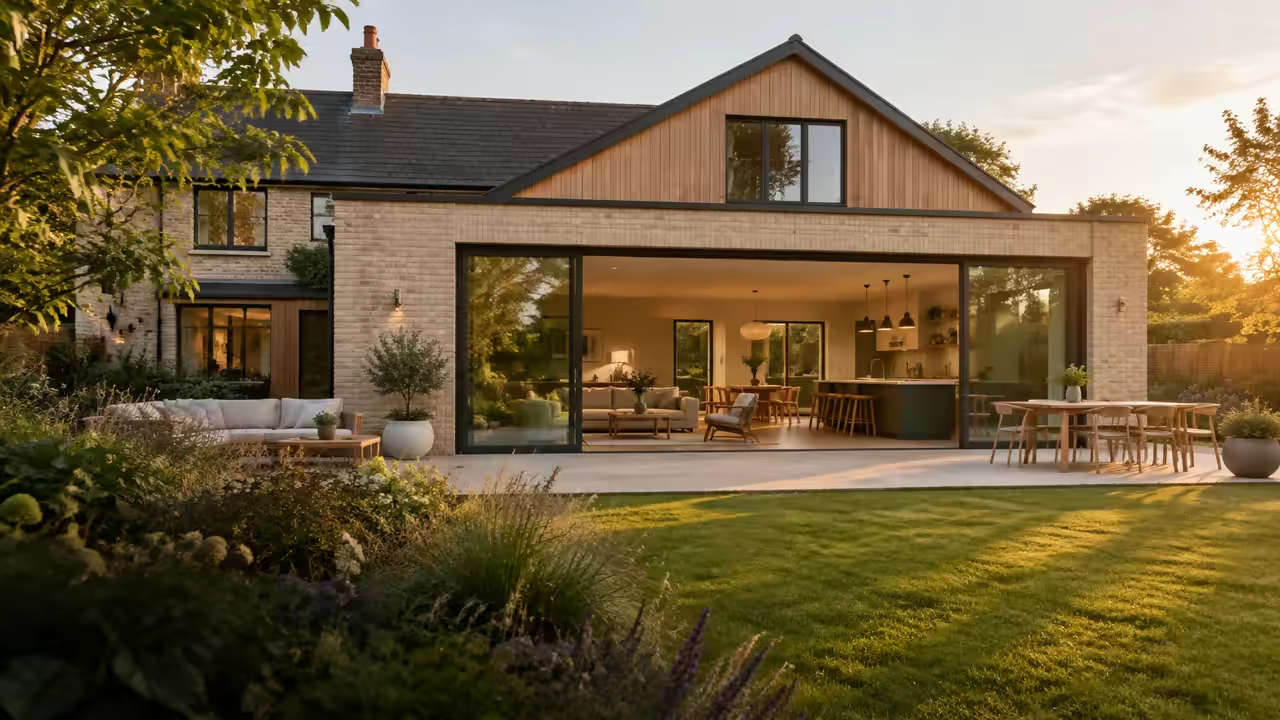
As soon as an extension opening stretches beyond two hinged leaves, French doors rely on fixed glazed side panels so the usable doorway stays unchanged. Bifolds let four, five or six leaves concertina neatly to one or both sides so kitchen and terrace merge into one continuous space. Use our bifold planner to test panel counts, traffic-door splits and stack positions for your exact width.
Maintenance and winter living
Remember that UK patio doors stay closed for most of the year. French doors have simple perimeter compression seals and familiar hinges; bifolds add top or bottom bogie rollers, intermediate shoot-bolts and floor track channels that benefit from occasional sweeping and silicone-free cleaning.
Side by side
| Compared | French doors | Bifold doors |
|---|---|---|
| Look and sightlines | A pair of hinged doors; traditional and familiar, often with side panels. | Several narrow panels. When closed you see a vertical frame every panel; when open the glass stacks to the side. |
| Maximum sizes | Maximum widths and heights for French doors depend on wind load and glass weight — confirm against the maker's size chart. | Varies by system; for reference, Alunet Aluna / BF73 and Eurocell Aluna publish aluminium bifold sashessash: A sash is the framed part of a window that holds the glass; it often describes the moving part. In a sliding sash window, glazed sashes move vertically. The word alone does not identify the material, balance mechanism or cleaning action, so ask what the complete window description actually means. More on sash |
| Thermal performance | Must meet building regulations. England, replacement doors over 60% glazed: maximum 1.4 W/m²K or DSERDSER: DSER means Door Set Energy Rating. It assesses an external door set as a complete assembly rather than judging the door glass on its own. The rating takes account of energy performance, including heat loss and air leakage. Ask whether the label covers the exact leaf, frame and glazing proposed. More on DSERU-valueU-value: A U-value describes how readily heat passes through a building element. A lower value means less heat loss through that element. For windows and doors, distinguish the complete assembly from the glass alone: a good glass figure does not establish the performance of the frame, edges and finished product. More on U-value | Must meet building regulations. England, replacement doors over 60% glazed: maximum 1.4 W/m²K or DSERDSER: DSER means Door Set Energy Rating. It assesses an external door set as a complete assembly rather than judging the door glass on its own. The rating takes account of energy performance, including heat loss and air leakage. Ask whether the label covers the exact leaf, frame and glazing proposed. More on DSERU-valueU-value: A U-value describes how readily heat passes through a building element. A lower value means less heat loss through that element. For windows and doors, distinguish the complete assembly from the glass alone: a good glass figure does not establish the performance of the frame, edges and finished product. More on U-value |
| Security standard | Look for PAS 24PAS 24: PAS 24 is a security test specification for complete windows and external door sets. It examines resistance to defined attack methods rather than promising that a product cannot be broken into. Evidence should relate to the actual system, configuration and hardware, not merely a lock or a broad product range. More on PAS 24 | Look for PAS 24PAS 24: PAS 24 is a security test specification for complete windows and external door sets. It examines resistance to defined attack methods rather than promising that a product cannot be broken into. Evidence should relate to the actual system, configuration and hardware, not merely a lock or a broad product range. More on PAS 24multi-point locksmultipoint lock: A multipoint lock secures a door at several positions along the edge, using a linked mechanism operated by the handle or key. It can help engagement with the frame but does not guarantee security on its own. Cylinders, keeps, hinges, glazing and the tested door assembly all matter together. More on multipoint locktraffic doorbifold traffic door: A bifold traffic door is a leaf that can be used for everyday passage without folding the full door set back. Its availability depends on the panel arrangement and system. It can make trips to the garden simpler, but its handle, lock and opening space still need checking in the proposed layout. More on bifold traffic door |
| Ease of use | Simple: open one leaf day to day, both for big access. | Fully open in one movement once you are used to it. A traffic doorbifold traffic door: A bifold traffic door is a leaf that can be used for everyday passage without folding the full door set back. Its availability depends on the panel arrangement and system. It can make trips to the garden simpler, but its handle, lock and opening space still need checking in the proposed layout. More on bifold traffic door |
| Maintenance | Low; hinges may need adjusting over time. | Keep tracks clean and clear; occasional hinge and roller checks. More moving parts than a slider. |
| Expected lifespan | Service life for French doors depends on exposure, specification and care — ask for the written frame, finish and hardware warranties. | Published UK aluminium bifold guarantees range from 10 years (Eurocell Aluna) up to 20 years (Origin Global, depending on location); hardware and coastal warranties are often shorter — check terms in writing. |
| Typical price band | French doors: from £700, averaging around £1,200 including installation (MyBuilder, last updated 21 Aug 2026); standard double-glazed £950 to £1,175 excluding building work (Checkatrade double-glazed doors guide, last updated Jun 2026); £1,700 to £3,125 when converting a window or creating an opening in a brick wall (Checkatrade French doors guide, last updated Jul 2026; checked 25 Nov 2026) (typical published UK range, supplied and fitted). | All bifold doors: £2,500 to £8,000 installed (MyBuilder, last updated 23 Oct 2026). Three-panel installed: uPVC £1,950 to £2,800, aluminium £3,150 to £4,650; each extra aluminium panel adds £650 to £1,500 (ExpertSure, verified Nov 2026, 20% VAT applies; checked 25 Nov 2026) (typical published UK range, supplied and fitted). |
| Best for | Smaller openings and traditional homes. | Opening a room fully to the garden, especially for summer use and entertaining. |
| Watch-outs | Doors swing into the room or garden, so allow clear space. | The stacked panels take up space inside or outside. More frames break up the view when closed. |
Figures from published manufacturer data, building regulations and UK cost guides. Your price will depend on your project.
Prices are published guide figures from the sources listed, not our own quotes. Installed prices vary by UK region, access, glazing specification and making good.
- Pilkington UK — Part L England existing dwellings guidance (Part L 2021 (in force June 2022)) — checked
- REHAU — Part L existing dwellings fact sheet (PDF) (2022 edition) — checked
- British Woodworking Federation — Part L new dwellings summary (2022 Part L update) — checked
- Pilkington UK — Scottish Building Standards Section 6 domestic guidance (2022/2023 Scottish Technical Handbook) — checked
- MyBuilder — French doors price guide (last updated 21 Aug 2026) — checked
- Checkatrade — French doors installation cost guide (last updated Jul 2026) — checked
- Checkatrade — Double glazed doors cost guide (last updated Jun 2026) — checked
- Alunet Systems — Aluna Bifold specification (undated manufacturer product page) — checked
- Eurocell — Aluna aluminium bi-fold doors specification (undated manufacturer product page) — checked
- Origin Global — Up to 20-year guarantee page (undated manufacturer guarantee page) — checked
- MyBuilder — Bifold doors price guide (last updated 23 Oct 2026) — checked
- ExpertSure — UK bifold door cost guide (prices verified Nov 2026; notes 20% VAT applies to bifold doors) — checked
Choose french doors if…
- the opening suits two leaves
- you want simplicity and fewer frames
- budget matters
Choose bifold doors if…
- the opening is too wide for two leaves
- opening the full width really matters
- you have space for the stack
Three real scenarios
Opening that fits two door leaves
French doors. A bifold here adds frames without adding much doorway.
Wide opening onto an entertaining terrace
Bifolds. This is what they are for.
Garden room on a tight budget
French doors with fixed side glazing gives light and a good doorway for less.
The team's verdict
Don't buy a bifold for an opening that two French doors would fill. For wider openings where the full width matters, bifolds are the right tool.
Questions people also ask
Are French doors cheaper than bifolds?
Usually, for the same opening. Get two or three itemised written quotes for your opening.
Can French doors fold back flat?
They swing back against the wall or the side frame, depending on the hinges.
Which is better for a small opening?
Usually French doors.
Do bifolds need more maintenance?
A little more: more hinges, rollers and track.
Last reviewed:
Answered by the Windows & Doors Answered team. How we write answers · Corrections policy
Related
Ask a free question
Didn't find your answer? Ask the team. The team usually replies within one working day.