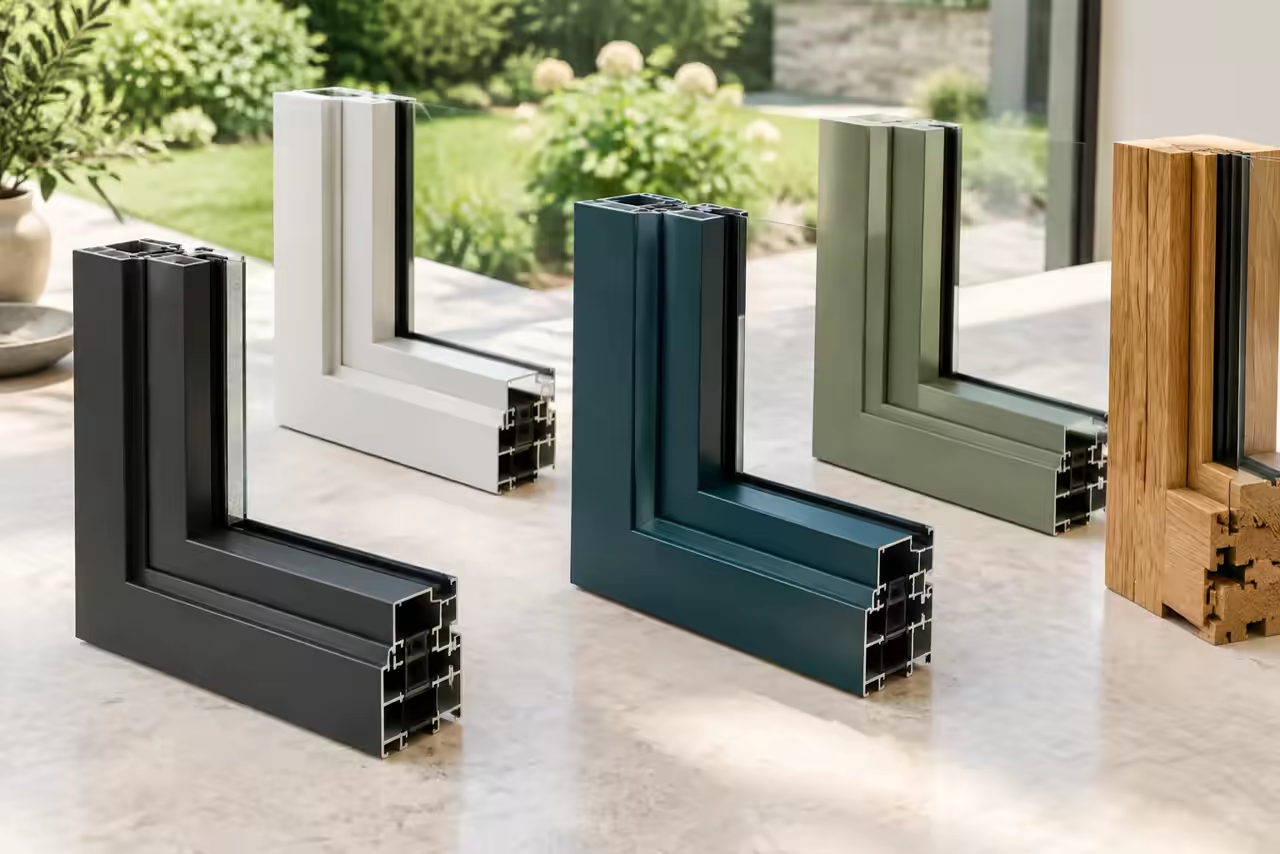
Comparison
Coastal home: powder coat vs anodised aluminium vs foils
Short answer
For a coastal home, no finish label gives a dependable lifespan ranking. aluminium, aluminium and foiled uPVC all need a specification supported for the actual exposure. Compare pretreatment, exposed edges, hardware and written coastal exclusions, then follow the care schedule. The best choice is an evidenced finish-and-frame package, not a promised maintenance-free surface.
Powder-coated
powder coating: Powder coating is a finish made by applying coating powder to a prepared metal surface and curing it to form a protective coloured layer. The quality of preparation and the specified coating system matter. A colour name alone does not establish suitability for coastal exposure, strong sunlight or a particular maintenance routine. More on powder coatinganodised
anodising: Anodising is an electrochemical process that develops a protective oxide layer on aluminium. It gives a different surface character from a painted coating, and the appearance can vary with alloy and processing. Suitability, colour consistency and care should be agreed for the exact product and exposure rather than assumed from the process name. More on anodisingPlanning this? Get a free, no-obligation installer recommendation
A finish comparison crosses frame materials
Powder coating
powder coating: Powder coating is a finish made by applying coating powder to a prepared metal surface and curing it to form a protective coloured layer. The quality of preparation and the specified coating system matter. A colour name alone does not establish suitability for coastal exposure, strong sunlight or a particular maintenance routine. More on powder coatinganodising
anodising: Anodising is an electrochemical process that develops a protective oxide layer on aluminium. It gives a different surface character from a painted coating, and the appearance can vary with alloy and processing. Suitability, colour consistency and care should be agreed for the exact product and exposure rather than assumed from the process name. More on anodisingfoil
foil (woodgrain): A woodgrain foil is a decorative surface layer bonded to a profile, commonly used on uPVC windows and doors to imitate painted or stained timber. It describes the finish, not the frame material. Texture, colour, corner joints and matching trims all affect how convincing the result looks on a real building. More on foil (woodgrain)Ask what is underneath and at the edges
For aluminium, ask about the specified treatment and coating or process for the site. For , ask about the exact film and bonding system. Inspect joints, drainage, exposed cut edges and fixing materials; a sound visible face is not the only part exposed to salt.
anodising
anodising: Anodising is an electrochemical process that develops a protective oxide layer on aluminium. It gives a different surface character from a painted coating, and the appearance can vary with alloy and processing. Suitability, colour consistency and care should be agreed for the exact product and exposure rather than assumed from the process name. More on anodisingfoil
foil (woodgrain): A woodgrain foil is a decorative surface layer bonded to a profile, commonly used on uPVC windows and doors to imitate painted or stained timber. It describes the finish, not the frame material. Texture, colour, corner joints and matching trims all affect how convincing the result looks on a real building. More on foil (woodgrain)Get the exclusions in writing
Ask how the supplier defines coastal exposure and whether shelter changes the cover. Confirm cleaning obligations, evidence you must retain and which party covers hardware. We do not invent service-life years or declare one process longest-lasting without comparable evidence. Obtain physical samples to judge colour and sheen.
Side by side
| Compared | Powder-coated aluminium | Anodised aluminium | Foiled uPVC |
|---|---|---|---|
| Look and sightlines | Coated colour finish; texture and sheen depend on the specified process. | Metallic finish formed on the aluminium surface; adjacent batches can differ in appearance. | A bonded decorative film with a woodgrainfoil (woodgrain): A woodgrain foil is a decorative surface layer bonded to a profile, commonly used on uPVC windows and doors to imitate painted or stained timber. It describes the finish, not the frame material. Texture, colour, corner joints and matching trims all affect how convincing the result looks on a real building. More on foil (woodgrain) |
| Maximum sizes | Depends on the product, not the colour — not applicable | Depends on the product, not the colour — not applicable | Depends on the product, not the colour — not applicable |
| Thermal performance | Depends on the product, not the colour — not applicable | Depends on the product, not the colour — not applicable | Depends on the product, not the colour — not applicable |
| Security standard | Depends on the product, not the colour — not applicable | Depends on the product, not the colour — not applicable | Depends on the product, not the colour — not applicable |
| Ease of use | Opening action comes from the window or door, not its finish. | Opening action comes from the window or door, not its finish. | Opening action comes from the window or door, not its finish. |
| Maintenance | Wash salt deposits off using the maker's coastal care instructions; attend to coating damage. | Follow the anodiser's cleaning instructions and check exposed edges and fixings. | Use compatible gentle cleaners; inspect foilfoil (woodgrain): A woodgrain foil is a decorative surface layer bonded to a profile, commonly used on uPVC windows and doors to imitate painted or stained timber. It describes the finish, not the frame material. Texture, colour, corner joints and matching trims all affect how convincing the result looks on a real building. More on foil (woodgrain) |
| Expected lifespan | Depends on the product, not the colour — not applicable | Depends on the product, not the colour — not applicable | Depends on the product, not the colour — not applicable |
| Typical price band | Depends on the product, not the colour — not applicable | Depends on the product, not the colour — not applicable | Depends on the product, not the colour — not applicable |
| Best for | Coastal projects needing a colour where the proposed pretreatment and coating are supported for the site. | Projects seeking a metallic face with a process specified for the exposure. | A timber-style coastal replacement where the actual foilfoil (woodgrain): A woodgrain foil is a decorative surface layer bonded to a profile, commonly used on uPVC windows and doors to imitate painted or stained timber. It describes the finish, not the frame material. Texture, colour, corner joints and matching trims all affect how convincing the result looks on a real building. More on foil (woodgrain) |
| Watch-outs | Colour name alone does not establish coastal suitability or warranty cover. | Do not infer salt resistance from the word anodisedanodising: Anodising is an electrochemical process that develops a protective oxide layer on aluminium. It gives a different surface character from a painted coating, and the appearance can vary with alloy and processing. Suitability, colour consistency and care should be agreed for the exact product and exposure rather than assumed from the process name. More on anodising | Hardware and reinforcement still need checking even though the visible frame is not aluminium. |
Choose powder-coated aluminium if…
- a coated colour suits the design
- the treatment is supported for the site
- you can meet the care conditions
Choose anodised aluminium if…
- a metallic appearance is wanted
- the specified process suits the exposure
- sample variation is acceptable
Choose foiled upvc if…
- a timber-style or foiled uPVC frame suits the opening
- the exact film is supported for the site
- hardware and edges have been assessed
Three real scenarios
Seafront elevation taking salt spray
Ask for the exact site's written finish and hardware support before choosing any appearance. A generic guarantee is not enough.
Sheltered coastal courtyard seeking a metallic face
Anodising
anodising: Anodising is an electrochemical process that develops a protective oxide layer on aluminium. It gives a different surface character from a painted coating, and the appearance can vary with alloy and processing. Suitability, colour consistency and care should be agreed for the exact product and exposure rather than assumed from the process name. More on anodisingCoastal cottage seeking timber-style replacements
A suitable may serve the appearance, but inspect joints and hardware and check local requirements. Do not equate a non-metal visible frame with an entirely corrosion-free assembly.
foil
foil (woodgrain): A woodgrain foil is a decorative surface layer bonded to a profile, commonly used on uPVC windows and doors to imitate painted or stained timber. It describes the finish, not the frame material. Texture, colour, corner joints and matching trims all affect how convincing the result looks on a real building. More on foil (woodgrain)The team's verdict
Choose for an appropriate supported colour finish, for a supported metallic finish, or for a suitable timber-style uPVC package. Another option suits better if the supplier cannot support your exposure and care routine. We cannot rank their lifespans from labels alone.
powder coat
powder coating: Powder coating is a finish made by applying coating powder to a prepared metal surface and curing it to form a protective coloured layer. The quality of preparation and the specified coating system matter. A colour name alone does not establish suitability for coastal exposure, strong sunlight or a particular maintenance routine. More on powder coatinganodising
anodising: Anodising is an electrochemical process that develops a protective oxide layer on aluminium. It gives a different surface character from a painted coating, and the appearance can vary with alloy and processing. Suitability, colour consistency and care should be agreed for the exact product and exposure rather than assumed from the process name. More on anodisingfoil
foil (woodgrain): A woodgrain foil is a decorative surface layer bonded to a profile, commonly used on uPVC windows and doors to imitate painted or stained timber. It describes the finish, not the frame material. Texture, colour, corner joints and matching trims all affect how convincing the result looks on a real building. More on foil (woodgrain)Questions people also ask
Which finish lasts longest by the sea?
Service life varies by coating grade, distance from the sea and wash routine rather than following one fixed ranking. Specification, exposure and care matter more than a generic ranking.
Is anodised aluminium immune to salt?
Do not assume that. Confirm the actual process, site suitability and cleaning instructions.
Does uPVC mean no coastal corrosion risk?
Visible uPVC is not the whole assembly. Hardware, reinforcement and fixings need assessment too.
Will coastal exclusions affect the guarantee?
They may. Read the exact terms for coating, , hardware and installation before ordering.
foil
foil (woodgrain): A woodgrain foil is a decorative surface layer bonded to a profile, commonly used on uPVC windows and doors to imitate painted or stained timber. It describes the finish, not the frame material. Texture, colour, corner joints and matching trims all affect how convincing the result looks on a real building. More on foil (woodgrain)Last reviewed:
Answered by the Windows & Doors Answered team. How we write answers · Corrections policy
Related
Ask a free question
Didn't find your answer? Ask the team. The team usually replies within one working day.