Comparison
Dual colour vs single colour: which suits your home?
Short answer
Dual colour
dual colour: Dual colour means that a window or door has different finishes on its outside and inside faces. It may be achieved through coatings, foils or separate components, depending on the material and system. Check what is visible at edges and when the sash or door is open, not only when closed. More on dual colourcasements
casement: A casement is a hinged window opening, usually attached at the side or top of its frame. It opens rather than sliding vertically like a traditional sliding sash. The hinge position and opening direction affect ventilation, cleaning, clear passage and conflicts with paths, taps, curtains or furniture. More on casementtrickle vents
trickle vent: A trickle vent is a small controllable opening intended to provide background ventilation through or near a window frame. It is different from opening the sash and does not replace extraction where that is needed. Whether vents are required depends on the building, ventilation strategy and applicable rules, not appearance alone. More on trickle ventcill
cill: A cill is the lower projecting section beneath a window or door frame that helps shed rainwater away from the wall. It is also spelt sill. Its projection, joints and connection to the frame need to suit the wall construction, so water does not collect or run into vulnerable junctions. More on cillPlanning this? Get a free, no-obligation installer recommendation
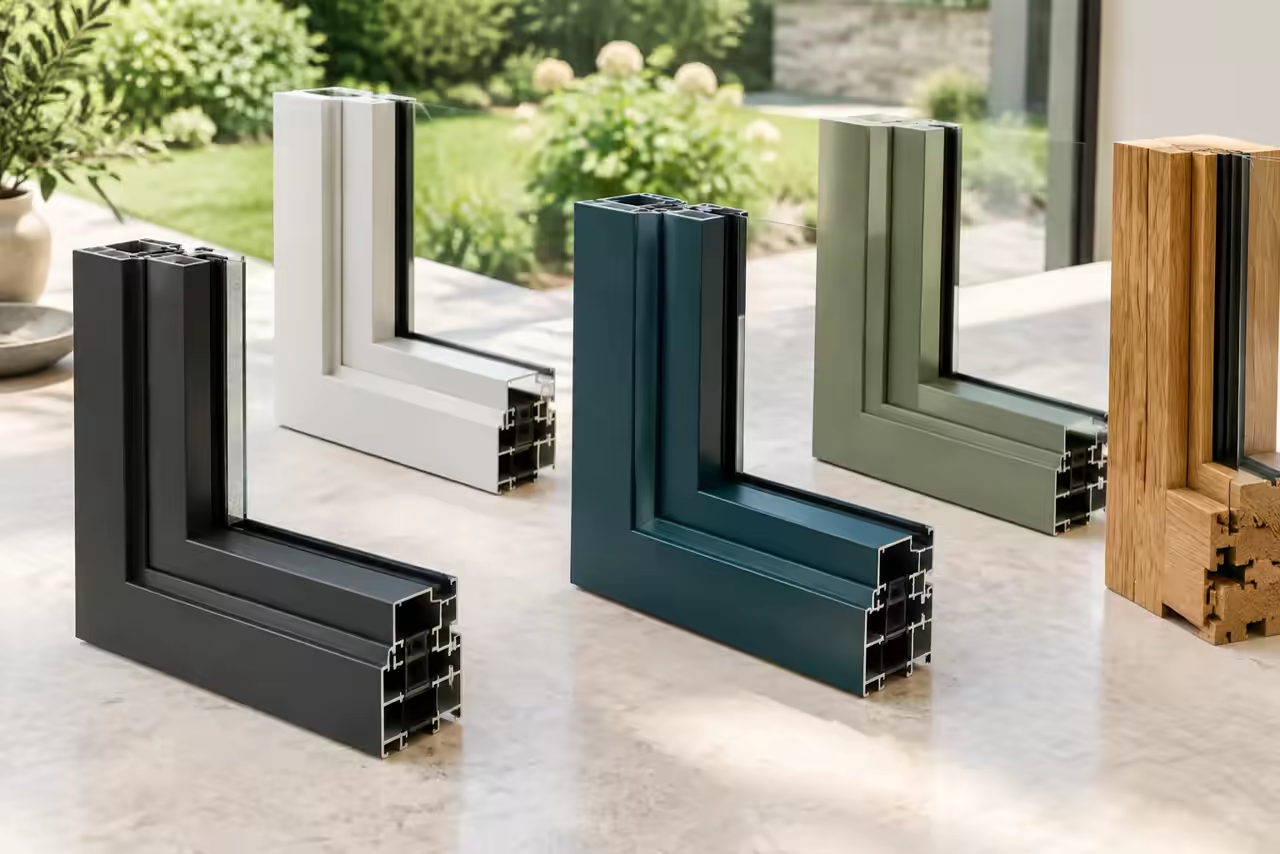
Illustration: on-screen colour is a guide
Exterior colour shown
Illustration: on-screen colour is a guide
Exterior colour shown
Colours on screen are a guide only. Confirm the exact finish and RAL code in writing on your quotation before ordering.
Free guidance. No fees. No sales calls.
What changes the decision?
Dual colour
dual colour: Dual colour means that a window or door has different finishes on its outside and inside faces. It may be achieved through coatings, foils or separate components, depending on the material and system. Check what is visible at edges and when the sash or door is open, not only when closed. More on dual colourCheck the complete finish package
Read the colour and finish guidance
Side by side
| Compared | Dual colour | Single colour |
|---|---|---|
| Look and sightlines | Different finishes inside and outside. | The same specified colour on both faces. |
| Maximum sizes | Depends on the product, not the colour — not applicable | Depends on the product, not the colour — not applicable |
| Thermal performance | Depends on the product, not the colour — not applicable | Depends on the product, not the colour — not applicable |
| Security standard | Depends on the product, not the colour — not applicable | Depends on the product, not the colour — not applicable |
| Ease of use | Dual colourdual colour: Dual colour means that a window or door has different finishes on its outside and inside faces. It may be achieved through coatings, foils or separate components, depending on the material and system. Check what is visible at edges and when the sash or door is open, not only when closed. More on dual colour | Single colour does not change how the window or door operates; test the specified product in a showroom. |
| Maintenance | Follow the finish supplier care guide for Dual colourdual colour: Dual colour means that a window or door has different finishes on its outside and inside faces. It may be achieved through coatings, foils or separate components, depending on the material and system. Check what is visible at edges and when the sash or door is open, not only when closed. More on dual colour | Follow the finish supplier care guide for Single colour; inspect a sample in daylight for marks and cleaning behaviour. |
| Expected lifespan | Depends on the product, not the colour — not applicable | Depends on the product, not the colour — not applicable |
| Typical price band | Depends on the product, not the colour — not applicable | Depends on the product, not the colour — not applicable |
| Best for | An exterior palette that need not dominate the rooms. | Continuity between the garden and rooms. |
| Watch-outs | Ask how rebates, edges, cillscill: A cill is the lower projecting section beneath a window or door frame that helps shed rainwater away from the wall. It is also spelt sill. Its projection, joints and connection to the frame need to suit the wall construction, so water does not collect or run into vulnerable junctions. More on cill | A strong exterior choice may feel heavier indoors. |
Choose dual colour if…
- the exterior and interior need different palettes
- the actual finish is available and suitable for the site
- the inside face, hardware and trims have been checked
Choose single colour if…
- you want deliberate continuity inside and outside
- the actual finish is available and suitable for the site
- the inside face, hardware and trims have been checked
Three real scenarios
Dark exterior with a small pale kitchen
A light inner face can reduce the frame’s visual weight. Confirm the open-door edge as well as the closed view so unexpected dark or white strips are avoided.
Modern room repeating exterior metalwork
Single colour can connect windows to the room’s other dark elements. Compare in evening light before deciding that continuity is worth the stronger outline.
Part replacement beside existing joinery
Specify each face to relate to the retained windows. Check and trims separately; a new frame may expose a different core when opened.
cills
cill: A cill is the lower projecting section beneath a window or door frame that helps shed rainwater away from the wall. It is also spelt sill. Its projection, joints and connection to the frame need to suit the wall construction, so water does not collect or run into vulnerable junctions. More on cilldual-colour
dual colour: Dual colour means that a window or door has different finishes on its outside and inside faces. It may be achieved through coatings, foils or separate components, depending on the material and system. Check what is visible at edges and when the sash or door is open, not only when closed. More on dual colourThe team's verdict
Dual colour
dual colour: Dual colour means that a window or door has different finishes on its outside and inside faces. It may be achieved through coatings, foils or separate components, depending on the material and system. Check what is visible at edges and when the sash or door is open, not only when closed. More on dual colourLast reviewed:
Answered by the Windows & Doors Answered team. How we write answers · Corrections policy
Related
Ask a free question
Didn't find your answer? Ask the team. The team usually replies within one working day.