Comparison
Inward vs outward opening bifold doors
Short answer
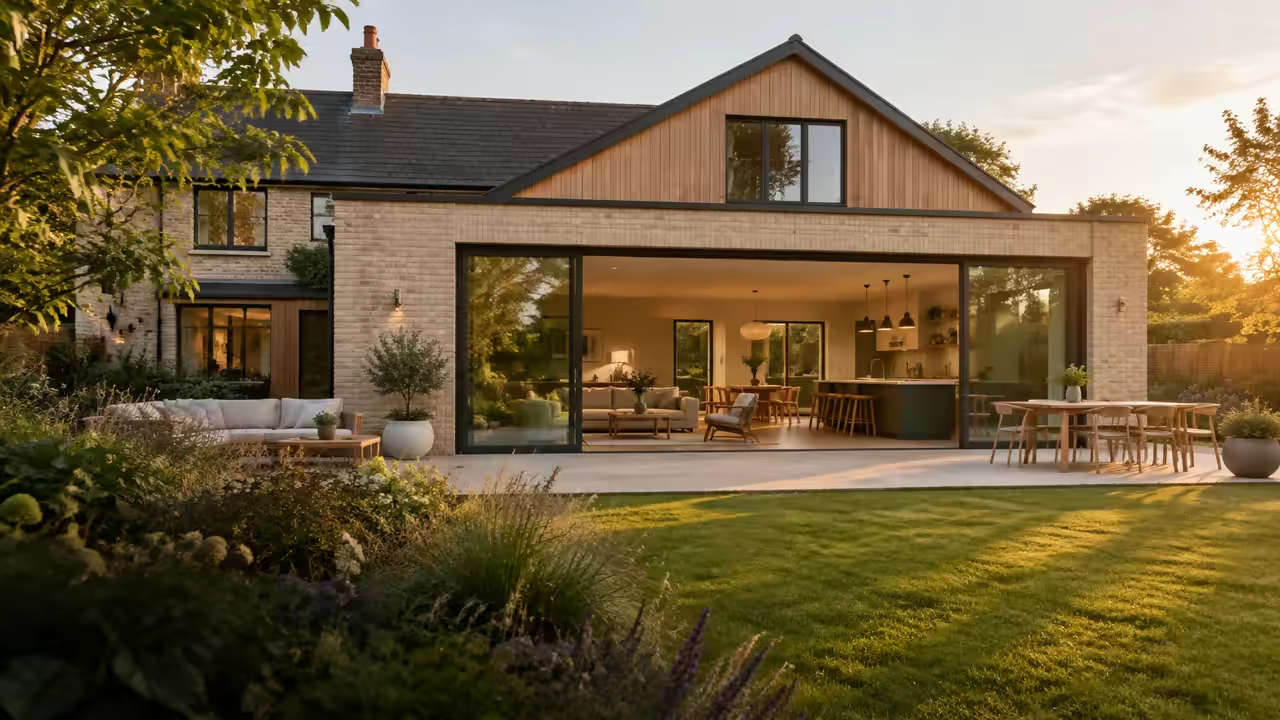
In the UK, most bifolds open outwards. The panels stack on the patio, the room stays clear, and the design usually resists driving rain better. Inward-opening bifolds suit balconies and tight terraces where there is no outside space, but the stack takes room inside. Check weather performance for inward systems.
Planning this? Get a free, no-obligation installer recommendation
Outward-opening bifolds are the standard UK choice because the folded panel stack stays out on the patio, indoor dining furniture sits untouched, and wind pressure pushes closed leaves tighter onto their weather gaskets; inward-opening bifolds are reserved for upper-floor balconies or tight courtyards where outside clearance simply does not exist.
Wind-driven rain and threshold drainage
When gales hit an outward-opening bifold, air pressure presses each leaf firmly against its internal rebate seals and rain sheds down the outer face onto the . On an inward-opening set, wind pushes the leaf *away* from the outer seal and rainwater dripping off open wet leaves falls straight onto indoor oak flooring or tiles — so always verify the manufacturer's water-tightness rating specifically for inward-opening configurations.
cill
cill: A cill is the lower projecting section beneath a window or door frame that helps shed rainwater away from the wall. It is also spelt sill. Its projection, joints and connection to the frame need to suit the wall construction, so water does not collect or run into vulnerable junctions. More on cillMapping the folded stack in real life
Each folded leaf projects almost its full panel width from the frame jamb when stacked open. On an inward-opening bifold, that stack can block kitchen island walkways, light switches, radiators or full-length curtains; on a narrow side-return patio where neither an inward nor an outward stack fits cleanly, switching to an inline sliding door solves the clearance problem completely.
Side by side
| Compared | Outward-opening bifolds | Inward-opening bifolds |
|---|---|---|
| Look and sightlines | Panels stack outside on the patio. | Panels stack inside the room. |
| Maximum sizes | Maximum widths and heights for Outward-opening bifolds depend on wind load and glass weight — confirm against the maker's size chart. | Maximum widths and heights for Inward-opening bifolds depend on wind load and glass weight — confirm against the maker's size chart. |
| Thermal performance | Must meet building regulations. England, replacement doors over 60% glazed: maximum 1.4 W/m²K or DSERDSER: DSER means Door Set Energy Rating. It assesses an external door set as a complete assembly rather than judging the door glass on its own. The rating takes account of energy performance, including heat loss and air leakage. Ask whether the label covers the exact leaf, frame and glazing proposed. More on DSERU-valueU-value: A U-value describes how readily heat passes through a building element. A lower value means less heat loss through that element. For windows and doors, distinguish the complete assembly from the glass alone: a good glass figure does not establish the performance of the frame, edges and finished product. More on U-value | Must meet building regulations. England, replacement doors over 60% glazed: maximum 1.4 W/m²K or DSERDSER: DSER means Door Set Energy Rating. It assesses an external door set as a complete assembly rather than judging the door glass on its own. The rating takes account of energy performance, including heat loss and air leakage. Ask whether the label covers the exact leaf, frame and glazing proposed. More on DSERU-valueU-value: A U-value describes how readily heat passes through a building element. A lower value means less heat loss through that element. For windows and doors, distinguish the complete assembly from the glass alone: a good glass figure does not establish the performance of the frame, edges and finished product. More on U-value |
| Security standard | Confirm PAS 24PAS 24: PAS 24 is a security test specification for complete windows and external door sets. It examines resistance to defined attack methods rather than promising that a product cannot be broken into. Evidence should relate to the actual system, configuration and hardware, not merely a lock or a broad product range. More on PAS 24 | Confirm PAS 24PAS 24: PAS 24 is a security test specification for complete windows and external door sets. It examines resistance to defined attack methods rather than promising that a product cannot be broken into. Evidence should relate to the actual system, configuration and hardware, not merely a lock or a broad product range. More on PAS 24 |
| Ease of use | No panels in the room when open. | Easy to open onto a balcony or small terrace. |
| Maintenance | As any bifold; the outside stack takes more weather. | As any bifold. |
| Expected lifespan | Service life for Outward-opening bifolds depends on exposure, specification and care — ask for the written frame, finish and hardware warranties. | Service life for Inward-opening bifolds depends on exposure, specification and care — ask for the written frame, finish and hardware warranties. |
| Typical price band | All bifold doors: £2,500 to £8,000 installed (MyBuilder, last updated 23 Oct 2026). Three-panel installed: uPVC £1,950 to £2,800, aluminium £3,150 to £4,650; each extra aluminium panel adds £650 to £1,500 (ExpertSure, verified Nov 2026, 20% VAT applies; checked 25 Nov 2026) (typical published UK range, supplied and fitted). | All bifold doors: £2,500 to £8,000 installed (MyBuilder, last updated 23 Oct 2026). Three-panel installed: uPVC £1,950 to £2,800, aluminium £3,150 to £4,650; each extra aluminium panel adds £650 to £1,500 (ExpertSure, verified Nov 2026, 20% VAT applies; checked 25 Nov 2026) (typical published UK range, supplied and fitted). |
| Best for | Most UK homes; usually better weather sealing against driving rain. | Balconies, tight patios and very sheltered elevations. |
| Watch-outs | The stack needs clear patio space and can catch the wind. | Stack takes floor space in the room; check weather performance. |
Figures from published manufacturer data, building regulations and UK cost guides. Your price will depend on your project.
Prices are published guide figures from the sources listed, not our own quotes. Installed prices vary by UK region, access, glazing specification and making good.
- Pilkington UK — Part L England existing dwellings guidance (Part L 2021 (in force June 2022)) — checked
- REHAU — Part L existing dwellings fact sheet (PDF) (2022 edition) — checked
- British Woodworking Federation — Part L new dwellings summary (2022 Part L update) — checked
- Pilkington UK — Scottish Building Standards Section 6 domestic guidance (2022/2023 Scottish Technical Handbook) — checked
- MyBuilder — Bifold doors price guide (last updated 23 Oct 2026) — checked
- ExpertSure — UK bifold door cost guide (prices verified Nov 2026; notes 20% VAT applies to bifold doors) — checked
Choose outward-opening bifolds if…
- there is patio space for the stack
- the site is exposed
- you want the room clear
Choose inward-opening bifolds if…
- the doors open onto a balcony
- the outside space is tight
- the elevation is sheltered
Three real scenarios
Ground-floor kitchen onto a large patio
Outward. The usual UK choice.
First-floor balcony
Inward. There is no room for panels outside.
Doors onto a narrow side return
Consider a slider instead. Neither stack position may work well.
The team's verdict
Outward-opening is the right default for most UK homes. Choose inward-opening only when outside space forces it, and then check the weather rating for your exposure.
Questions people also ask
Why do most UK bifolds open out?
Better weather resistance and a clear room.
Do outward bifolds blow shut?
Use the restraints and stops provided.
Can inward bifolds have a low threshold?
Sometimes, but drainage needs extra care.
Can panels stack on both sides?
Yes, with a split configuration.
Last reviewed:
Answered by the Windows & Doors Answered team. How we write answers · Corrections policy
Related
Ask a free question
Didn't find your answer? Ask the team. The team usually replies within one working day.