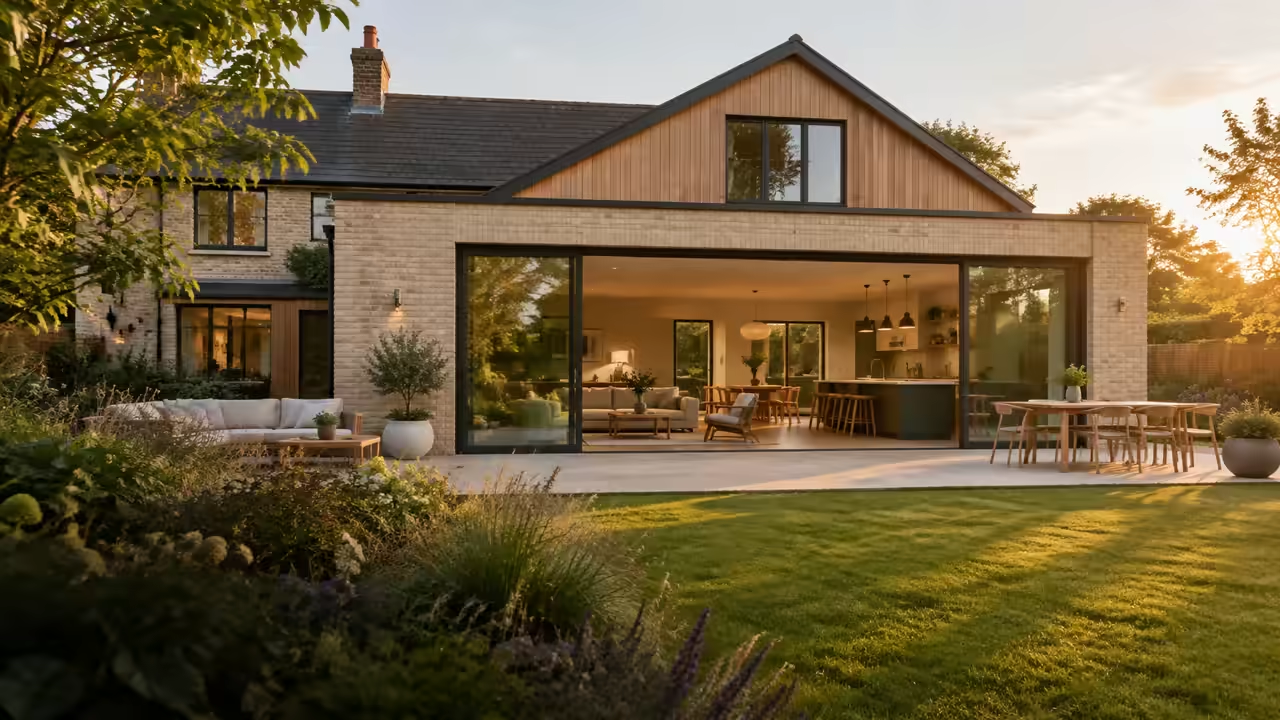
Comparison
Lift-and-slide vs bifold doors: which works better for a wide garden opening?
Short answer
Choose doors when uninterrupted winter views, effortless heavy-panel glide and strong perimeter weather compression matter more than folding the entire wall away. Choose bifold doors when opening nearly the full aperture onto a patio for summer gatherings outweighs having more vertical frame when shut.
lift-and-slide
lift-and-slide: Lift-and-slide describes a sliding door mechanism in which the handle lifts the moving leaf from its sealing position for travel, then lowers it back when closing. It can help with heavier leaves, but operating effort still depends on the complete system, adjustment, handle and installation rather than the mechanism name alone. More on lift-and-slidemullions
mullion: A mullion is a vertical dividing member within a window or glazed screen. It separates adjacent lights or sections and may provide structural support as part of the assembly. It is different from a decorative glazing bar. Its position and width affect the view, visible glass and arrangement of opening parts. More on mullionPlanning this? Get a free, no-obligation installer recommendation
How you live with them ten months of the year
In the UK climate, garden doors stay closed far more days than they stand fully stacked open. doors reward you through autumn and winter with vast uninterrupted panes, whereas bifolds divide the same width into narrower concertina leaves with more vertical .
Lift-and-slide
lift-and-slide: Lift-and-slide describes a sliding door mechanism in which the handle lifts the moving leaf from its sealing position for travel, then lowers it back when closing. It can help with heavier leaves, but operating effort still depends on the complete system, adjustment, handle and installation rather than the mechanism name alone. More on lift-and-slidesightlines
sightline: A sightline is the visible width of frame you see when you look at a window or door. Slimmer sightlines mean more glass and less frame. Makers sometimes measure it differently, so compare drawings of the exact products, especially where fixed and opening panes sit side by side. More on sightlineOperating effort and partial ventilation
Turning a handle raises heavy double- or triple-glazed panels effortlessly onto concealed carriages and lets you lock the cleanly in a partial open position. Bifolds are brilliant fully folded back, though opening just one side routinely works best when an odd-panel layout includes an independent .
lift-and-slide
lift-and-slide: Lift-and-slide describes a sliding door mechanism in which the handle lifts the moving leaf from its sealing position for travel, then lowers it back when closing. It can help with heavier leaves, but operating effort still depends on the complete system, adjustment, handle and installation rather than the mechanism name alone. More on lift-and-slidesash
sash: A sash is the framed part of a window that holds the glass; it often describes the moving part. In a sliding sash window, glazed sashes move vertically. The word alone does not identify the material, balance mechanism or cleaning action, so ask what the complete window description actually means. More on sashtraffic door
bifold traffic door: A bifold traffic door is a leaf that can be used for everyday passage without folding the full door set back. Its availability depends on the panel arrangement and system. It can make trips to the garden simpler, but its handle, lock and opening space still need checking in the proposed layout. More on bifold traffic doorWeather sealing and track space
Because a drops directly onto continuous gaskets when closed, it often feels tighter in driving wind than multi-hinged bifold seals. panels also glide parallel along their own track, leaving patio furniture right beside the glass undisturbed.
lift-and-slide
lift-and-slide: Lift-and-slide describes a sliding door mechanism in which the handle lifts the moving leaf from its sealing position for travel, then lowers it back when closing. It can help with heavier leaves, but operating effort still depends on the complete system, adjustment, handle and installation rather than the mechanism name alone. More on lift-and-slidesash
sash: A sash is the framed part of a window that holds the glass; it often describes the moving part. In a sliding sash window, glazed sashes move vertically. The word alone does not identify the material, balance mechanism or cleaning action, so ask what the complete window description actually means. More on sashLift-and-slide
lift-and-slide: Lift-and-slide describes a sliding door mechanism in which the handle lifts the moving leaf from its sealing position for travel, then lowers it back when closing. It can help with heavier leaves, but operating effort still depends on the complete system, adjustment, handle and installation rather than the mechanism name alone. More on lift-and-slideSide by side
| Compared | Lift-and-slide doors | Bifold doors |
|---|---|---|
| Look and sightlines | Very large panes; deeper frames than some inline systems. | Several narrow panels. When closed you see a vertical frame every panel; when open the glass stacks to the side. |
| Maximum sizes | Maximum widths and heights for Lift-and-slidelift-and-slide: Lift-and-slide describes a sliding door mechanism in which the handle lifts the moving leaf from its sealing position for travel, then lowers it back when closing. It can help with heavier leaves, but operating effort still depends on the complete system, adjustment, handle and installation rather than the mechanism name alone. More on lift-and-slide | Varies by system; for reference, Alunet Aluna / BF73 and Eurocell Aluna publish aluminium bifold sashessash: A sash is the framed part of a window that holds the glass; it often describes the moving part. In a sliding sash window, glazed sashes move vertically. The word alone does not identify the material, balance mechanism or cleaning action, so ask what the complete window description actually means. More on sash |
| Thermal performance | Must meet building regulations. England, replacement doors over 60% glazed: maximum 1.4 W/m²K or DSERDSER: DSER means Door Set Energy Rating. It assesses an external door set as a complete assembly rather than judging the door glass on its own. The rating takes account of energy performance, including heat loss and air leakage. Ask whether the label covers the exact leaf, frame and glazing proposed. More on DSERU-valueU-value: A U-value describes how readily heat passes through a building element. A lower value means less heat loss through that element. For windows and doors, distinguish the complete assembly from the glass alone: a good glass figure does not establish the performance of the frame, edges and finished product. More on U-value | Must meet building regulations. England, replacement doors over 60% glazed: maximum 1.4 W/m²K or DSERDSER: DSER means Door Set Energy Rating. It assesses an external door set as a complete assembly rather than judging the door glass on its own. The rating takes account of energy performance, including heat loss and air leakage. Ask whether the label covers the exact leaf, frame and glazing proposed. More on DSERU-valueU-value: A U-value describes how readily heat passes through a building element. A lower value means less heat loss through that element. For windows and doors, distinguish the complete assembly from the glass alone: a good glass figure does not establish the performance of the frame, edges and finished product. More on U-value |
| Security standard | Confirm PAS 24PAS 24: PAS 24 is a security test specification for complete windows and external door sets. It examines resistance to defined attack methods rather than promising that a product cannot be broken into. Evidence should relate to the actual system, configuration and hardware, not merely a lock or a broad product range. More on PAS 24Lift-and-slidelift-and-slide: Lift-and-slide describes a sliding door mechanism in which the handle lifts the moving leaf from its sealing position for travel, then lowers it back when closing. It can help with heavier leaves, but operating effort still depends on the complete system, adjustment, handle and installation rather than the mechanism name alone. More on lift-and-slide | Look for PAS 24PAS 24: PAS 24 is a security test specification for complete windows and external door sets. It examines resistance to defined attack methods rather than promising that a product cannot be broken into. Evidence should relate to the actual system, configuration and hardware, not merely a lock or a broad product range. More on PAS 24multi-point locksmultipoint lock: A multipoint lock secures a door at several positions along the edge, using a linked mechanism operated by the handle or key. It can help engagement with the frame but does not guarantee security on its own. Cylinders, keeps, hinges, glazing and the tested door assembly all matter together. More on multipoint locktraffic doorbifold traffic door: A bifold traffic door is a leaf that can be used for everyday passage without folding the full door set back. Its availability depends on the panel arrangement and system. It can make trips to the garden simpler, but its handle, lock and opening space still need checking in the proposed layout. More on bifold traffic door |
| Ease of use | Turn the handle to lift, then very heavy panes glide easily. | Fully open in one movement once you are used to it. A traffic doorbifold traffic door: A bifold traffic door is a leaf that can be used for everyday passage without folding the full door set back. Its availability depends on the panel arrangement and system. It can make trips to the garden simpler, but its handle, lock and opening space still need checking in the proposed layout. More on bifold traffic door |
| Maintenance | Clean the track; the lifting gear rarely needs attention. | Keep tracks clean and clear; occasional hinge and roller checks. More moving parts than a slider. |
| Expected lifespan | Service life for Lift-and-slidelift-and-slide: Lift-and-slide describes a sliding door mechanism in which the handle lifts the moving leaf from its sealing position for travel, then lowers it back when closing. It can help with heavier leaves, but operating effort still depends on the complete system, adjustment, handle and installation rather than the mechanism name alone. More on lift-and-slide | Published UK aluminium bifold guarantees range from 10 years (Eurocell Aluna) up to 20 years (Origin Global, depending on location); hardware and coastal warranties are often shorter — check terms in writing. |
| Typical price band | Installed cost for Lift-and-slidelift-and-slide: Lift-and-slide describes a sliding door mechanism in which the handle lifts the moving leaf from its sealing position for travel, then lowers it back when closing. It can help with heavier leaves, but operating effort still depends on the complete system, adjustment, handle and installation rather than the mechanism name alone. More on lift-and-slide | All bifold doors: £2,500 to £8,000 installed (MyBuilder, last updated 23 Oct 2026). Three-panel installed: uPVC £1,950 to £2,800, aluminium £3,150 to £4,650; each extra aluminium panel adds £650 to £1,500 (ExpertSure, verified Nov 2026, 20% VAT applies; checked 25 Nov 2026) (typical published UK range, supplied and fitted). |
| Best for | Very large or heavy panes and exposed sites needing strong sealing. | Opening a room fully to the garden, especially for summer use and entertaining. |
| Watch-outs | Higher cost; overkill for modest openings. | The stacked panels take up space inside or outside. More frames break up the view when closed. |
Figures from published manufacturer data, building regulations and UK cost guides. Your price will depend on your project.
Prices are published guide figures from the sources listed, not our own quotes. Installed prices vary by UK region, access, glazing specification and making good.
- Pilkington UK — Part L England existing dwellings guidance (Part L 2021 (in force June 2022)) — checked
- REHAU — Part L existing dwellings fact sheet (PDF) (2022 edition) — checked
- British Woodworking Federation — Part L new dwellings summary (2022 Part L update) — checked
- Pilkington UK — Scottish Building Standards Section 6 domestic guidance (2022/2023 Scottish Technical Handbook) — checked
- Alunet Systems — Aluna Bifold specification (undated manufacturer product page) — checked
- Eurocell — Aluna aluminium bi-fold doors specification (undated manufacturer product page) — checked
- Origin Global — Up to 20-year guarantee page (undated manufacturer guarantee page) — checked
- MyBuilder — Bifold doors price guide (last updated 23 Oct 2026) — checked
- ExpertSure — UK bifold door cost guide (prices verified Nov 2026; notes 20% VAT applies to bifold doors) — checked
Choose lift-and-slide doors if…
- Panoramic glass views all year round with minimal vertical bars obstructing the garden.
- Exposed hillsides or coastal elevations benefiting from drop-down compression gaskets.
- Quick, effortless one-handed opening to any partial position without folding panels.
Choose bifold doors if…
- Opening up almost the full structural width so kitchen and terrace merge completely.
- Medium openings where a dedicated handles daily garden trips cleanly.
traffic door
bifold traffic door: A bifold traffic door is a leaf that can be used for everyday passage without folding the full door set back. Its availability depends on the panel arrangement and system. It can make trips to the garden simpler, but its handle, lock and opening space still need checking in the proposed layout. More on bifold traffic door - Homes wanting panels stacked neatly outside or inside at one end of the aperture.
Three real scenarios
Exposed rural kitchen looking across open fields
Lift-and-slide
lift-and-slide: Lift-and-slide describes a sliding door mechanism in which the handle lifts the moving leaf from its sealing position for travel, then lowers it back when closing. It can help with heavier leaves, but operating effort still depends on the complete system, adjustment, handle and installation rather than the mechanism name alone. More on lift-and-slideCompact courtyard garden used for summer entertaining
Bifold doors with a traffic leaf fold back cleanly to connect a smaller room directly onto the terrace.
Families with young children
Lift-and-slide
lift-and-slide: Lift-and-slide describes a sliding door mechanism in which the handle lifts the moving leaf from its sealing position for travel, then lowers it back when closing. It can help with heavier leaves, but operating effort still depends on the complete system, adjustment, handle and installation rather than the mechanism name alone. More on lift-and-slidesashes
sash: A sash is the framed part of a window that holds the glass; it often describes the moving part. In a sliding sash window, glazed sashes move vertically. The word alone does not identify the material, balance mechanism or cleaning action, so ask what the complete window description actually means. More on sashThe team's verdict
Choose for big glass, calm weather sealing and zero furniture clash; choose bifolds when folding nearly the whole wall open is your top summer priority.
lift-and-slide
lift-and-slide: Lift-and-slide describes a sliding door mechanism in which the handle lifts the moving leaf from its sealing position for travel, then lowers it back when closing. It can help with heavier leaves, but operating effort still depends on the complete system, adjustment, handle and installation rather than the mechanism name alone. More on lift-and-slideQuestions people also ask
Do lift-and-slide doors open as wide as bifolds?
No—a two-panel slider opens roughly half the aperture and a three-panel triple-track opens roughly two-thirds, whereas bifolds clear almost the whole opening.
Are lift-and-slide doors warmer than bifold doors?
Fewer vertical and continuous perimeter compression gaskets typically help doors achieve strong thermal and airtightness figures.
mullions
mullion: A mullion is a vertical dividing member within a window or glazed screen. It separates adjacent lights or sections and may provide structural support as part of the assembly. It is different from a decorative glazing bar. Its position and width affect the view, visible glass and arrangement of opening parts. More on mullionlift-and-slide
lift-and-slide: Lift-and-slide describes a sliding door mechanism in which the handle lifts the moving leaf from its sealing position for travel, then lowers it back when closing. It can help with heavier leaves, but operating effort still depends on the complete system, adjustment, handle and installation rather than the mechanism name alone. More on lift-and-slideWhich system costs more?
Heavy hardware and oversized glass panes often price slightly above standard bifolds, especially if crane or glass-lifter access is needed.
lift-and-slide
lift-and-slide: Lift-and-slide describes a sliding door mechanism in which the handle lifts the moving leaf from its sealing position for travel, then lowers it back when closing. It can help with heavier leaves, but operating effort still depends on the complete system, adjustment, handle and installation rather than the mechanism name alone. More on lift-and-slideCan both have a low threshold?
Yes—both offer low- options, though exposed elevations still benefit from a weathered upstand or linear external drainage.
threshold
threshold: A threshold is the bottom part of a door set that you cross when entering or leaving. It connects the door seals, drainage and floor levels. A low or visually flush threshold can make movement easier, but it still needs an appropriate weather detail and a properly planned external water route. More on thresholdLast reviewed:
Answered by the Windows & Doors Answered team. How we write answers · Corrections policy
Related
Ask a free question
Didn't find your answer? Ask the team. The team usually replies within one working day.