Product hub
Composite doors
Free guidance. No fees. No sales calls.
Short answer
Composite doors bond a rigid outer skin — usually GRP or thermoplastic — onto an insulating solid timber or high-density foam core inside a reinforced outer frame. They give traditional panelled styling, low maintenance and strong winter insulation at a lower price than bespoke aluminium or hardwood, though quality varies sharply between makers.
woodgrain
foil (woodgrain): A woodgrain foil is a decorative surface layer bonded to a profile, commonly used on uPVC windows and doors to imitate painted or stained timber. It describes the finish, not the frame material. Texture, colour, corner joints and matching trims all affect how convincing the result looks on a real building. More on foil (woodgrain)Planning this? Get a free, no-obligation installer recommendation
Key facts at a glance
| Fact | UK guide figure or rule | Source & checked |
|---|---|---|
| Typical price range | Typical installed front door range is £1,000 to £2,000 (average £1,500), with bespoke solid-core or sidelight designs above £2,000 (MyBuilder front door guide, last updated 21 Aug 2026; checked 25 Nov 2026). | MyBuilder new front door cost guide (last updated 21 Aug 2026)Checked 25 November 2026 |
| U-value range | England replacement doors (≤60% glazed) max 1.4 W/m²K (or DSERDSER: DSER means Door Set Energy Rating. It assesses an external door set as a complete assembly rather than judging the door glass on its own. The rating takes account of energy performance, including heat loss and air leakage. Ask whether the label covers the exact leaf, frame and glazing proposed. More on DSER | Part L (England) & Section 6 (Scotland)Checked 23 November 2026 |
| Lifespan | Major UK composite makers such as Rockdoor and Solidor publish 10-year door guarantees (Rockdoor: 10 years on sashsash: A sash is the framed part of a window that holds the glass; it often describes the moving part. In a sliding sash window, glazed sashes move vertically. The word alone does not identify the material, balance mechanism or cleaning action, so ask what the complete window description actually means. More on sash | Rockdoor & Solidor guarantee terms (undated manufacturer pages)Checked 25 November 2026 |
| Maintenance | Low. Wipe the GRP or thermoplastic skin with warm soapy water (never abrasives or solvents), keep thresholdthreshold: A threshold is the bottom part of a door set that you cross when entering or leaving. It connects the door seals, drainage and floor levels. A low or visually flush threshold can make movement easier, but it still needs an appropriate weather detail and a properly planned external water route. More on threshold | Windows & Doors Answered trade teamChecked 24 November 2026 |
| Security standards | Look for full PAS 24PAS 24: PAS 24 is a security test specification for complete windows and external door sets. It examines resistance to defined attack methods rather than promising that a product cannot be broken into. Evidence should relate to the actual system, configuration and hardware, not merely a lock or a broad product range. More on PAS 24Secured by DesignSecured by Design: Secured by Design is a police security initiative that includes an approval scheme for products such as windows and doors. It is not a general guarantee against crime. Check the current listing for the proposed product and distinguish product approval from wider recommendations about the design of a building. More on Secured by Designlaminated glasslaminated glass: Laminated glass has glass layers bonded around an interlayer that can hold broken pieces together. Depending on its specification, it may serve safety, security or acoustic purposes. Those functions are not automatic: the glass build-up, supporting frame and tested application decide what protection the complete assembly can provide. More on laminated glass | GOV.UK Approved Document Q / Secured by DesignChecked 24 November 2026 |
| Lead time | Stock composite colours and standard styles are typically quicker than custom sprayed colours, stable doors or matching sidelight frames. | Awaiting maker data |
Colour visualiser
See RAL 6005 on a front door on a red brick houseThis is general information, not planning, building-regulations or legal advice. Rules depend on the property, the work and the nation you live in. Confirm your own project with your local council or building control body before ordering.
What are composite doors?
A composite door combines different materials to overcome the weaknesses of single-material doors: an insulating core (either high-density polyurethane foam or a solid laminated timber core) is encapsulated by impact-resistant outer skins (typically glass-reinforced plastic / GRP or colour-through thermoplastic ABS) and hung inside a steel-reinforced uPVC or aluminium outer frame.
thermally broken
thermal break: A thermal break is a less conductive connection separating the inner and outer parts of a metal frame to reduce heat flow through it. It helps improve frame performance but does not determine the whole window result alone. Glass, spacers, geometry and the installation junction all remain part of the assessment. More on thermal breakThe result feels heavier and more solid than a basic uPVC panel door, resists the swelling and annual repainting of traditional softwood, and offers dozens of cottage, Victorian, Georgian and contemporary styles.
Types and opening styles of composite doors
Core construction and style details separate budget composite doors from long-lasting ones:
- Solid timber-core composite doors (typically ~48 mm thick): Heavy, dense laminated timber core offering reassuring solidity and strong screw retention for locks and hinges.
- High-density foam-core GRP composite doors (typically ~44 mm thick): Lighter leaf with strong thermal insulation and crisp -embossed fibreglass skins.
woodgrain
foil (woodgrain): A woodgrain foil is a decorative surface layer bonded to a profile, commonly used on uPVC windows and doors to imitate painted or stained timber. It describes the finish, not the frame material. Texture, colour, corner joints and matching trims all affect how convincing the result looks on a real building. More on foil (woodgrain) - Stable composite doors: Split top-and-bottom leaves popular on cottages and kitchens so the top half opens for ventilation while keeping pets or toddlers inside.
- Composite doors with matching sidelights: Coupled uPVC or aluminium side frames bringing natural light into dark hallways.
Always check whether the outer frame colour is foiled to match your door leaf cleanly or left plain white — a crisp colour-matched outer frame looks noticeably smarter from the pavement.
Pros and cons of composite doors
Where they work well
- Huge range of traditional cottage, Victorian and contemporary panelled designs.
- Strong thermal efficiency and draught-tight perimeter seals.
- Low routine maintenance — wipe clean with soapy water, no repainting.
- Typically more affordable than bespoke insulated aluminium or engineered hardwood entrance doors.
Where to be cautious
- Dark composite doors in direct south-facing sun without a porch can experience slight seasonal thermal bowing.
- Quality varies hugely between budget 44 mm doors and premium solid-core systems.
PAS 24
PAS 24: PAS 24 is a security test specification for complete windows and external door sets. It examines resistance to defined attack methods rather than promising that a product cannot be broken into. Evidence should relate to the actual system, configuration and hardware, not merely a lock or a broad product range. More on PAS 24 - Generally limited to standard residential door widths and heights (unlike oversized aluminium or pivot doors).
- Not usually accepted on listed buildings where authentic timber joinery is mandated.
How much do composite doors cost in the UK?
UK composite door price ranges vary because installed quotes vary depending on foam vs solid-timber core, brand, decorative glazing, sidelights, outer frame colour, hardware suite and making good.
What drives the price up or down
- Core type and thickness: Solid laminated timber cores typically cost more than entry-level foam cores.
- Glazing design: Large laminated decorative, satin or triple-glazed leaded cassettes add cost over solid panelled slabs.
- Custom colours and coloured outer frames: Heritage/custom spray finishes and foiled frames add to standard colours.
RAL
RAL: RAL is a colour reference system used to specify finishes, including many coated aluminium windows and doors. A reference identifies a colour target, not a guarantee that different materials or finishes will look identical. Surface texture, gloss, lighting and the coating process can alter how the chosen shade appears. More on RAL - Locking and hardware: Auto-slam heritage locks, stainless marine-grade hardware and TS008 letterplates add to standard suites.
Worked cost example
Composite-door installed costs vary by slab core and glazing layout. Compare three itemised quotes listing: door brand, core material (solid timber vs foam), slab thickness, outer frame colour, status, 3-star cylinder brand, type and fitting/making good.
PAS 24
PAS 24: PAS 24 is a security test specification for complete windows and external door sets. It examines resistance to defined attack methods rather than promising that a product cannot be broken into. Evidence should relate to the actual system, configuration and hardware, not merely a lock or a broad product range. More on PAS 24threshold
threshold: A threshold is the bottom part of a door set that you cross when entering or leaving. It connects the door seals, drainage and floor levels. A low or visually flush threshold can make movement easier, but it still needs an appropriate weather detail and a properly planned external water route. More on thresholdBudgeting and quote tools
Thermal performance and Part L / Scotland rules
Insulated composite slabs perform strongly on winter heat retention, comfortably meeting the 1.4 W/m²K England and Scotland replacement limit when fitted into a properly sealed outer frame with a thermal and draught-proof letterplate (or no letterplate at all).
threshold
threshold: A threshold is the bottom part of a door set that you cross when entering or leaving. It connects the door seals, drainage and floor levels. A low or visually flush threshold can make movement easier, but it still needs an appropriate weather detail and a properly planned external water route. More on thresholdThermal and glazing tools
Security: PAS 24 and Secured by Design
Check that security testing covers the complete door set — slab, frame, hinges, glazing cassette and multi-point hook lock — to / , backed by a TS007 3-star anti-snap cylinder and in reachable panes.
PAS 24
PAS 24: PAS 24 is a security test specification for complete windows and external door sets. It examines resistance to defined attack methods rather than promising that a product cannot be broken into. Evidence should relate to the actual system, configuration and hardware, not merely a lock or a broad product range. More on PAS 24Secured by Design
Secured by Design: Secured by Design is a police security initiative that includes an approval scheme for products such as windows and doors. It is not a general guarantee against crime. Check the current listing for the proposed product and distinguish product approval from wider recommendations about the design of a building. More on Secured by Designlaminated glass
laminated glass: Laminated glass has glass layers bonded around an interlayer that can hold broken pieces together. Depending on its specification, it may serve safety, security or acoustic purposes. Those functions are not automatic: the glass build-up, supporting frame and tested application decide what protection the complete assembly can provide. More on laminated glassNoise and acoustic performance
Dense solid-core composite doors paired with double perimeter weather gaskets cut street chatter and traffic noise far better than lightweight uPVC panel doors.
Lifespan and maintenance
Composite-door service life depends on specification, exposure and written warranties. Clean skins with warm soapy water, avoid harsh polishes, check hinge adjustment if the latch ever catches in summer heat, and keep lock keeps lightly oiled.
Colours and finishes
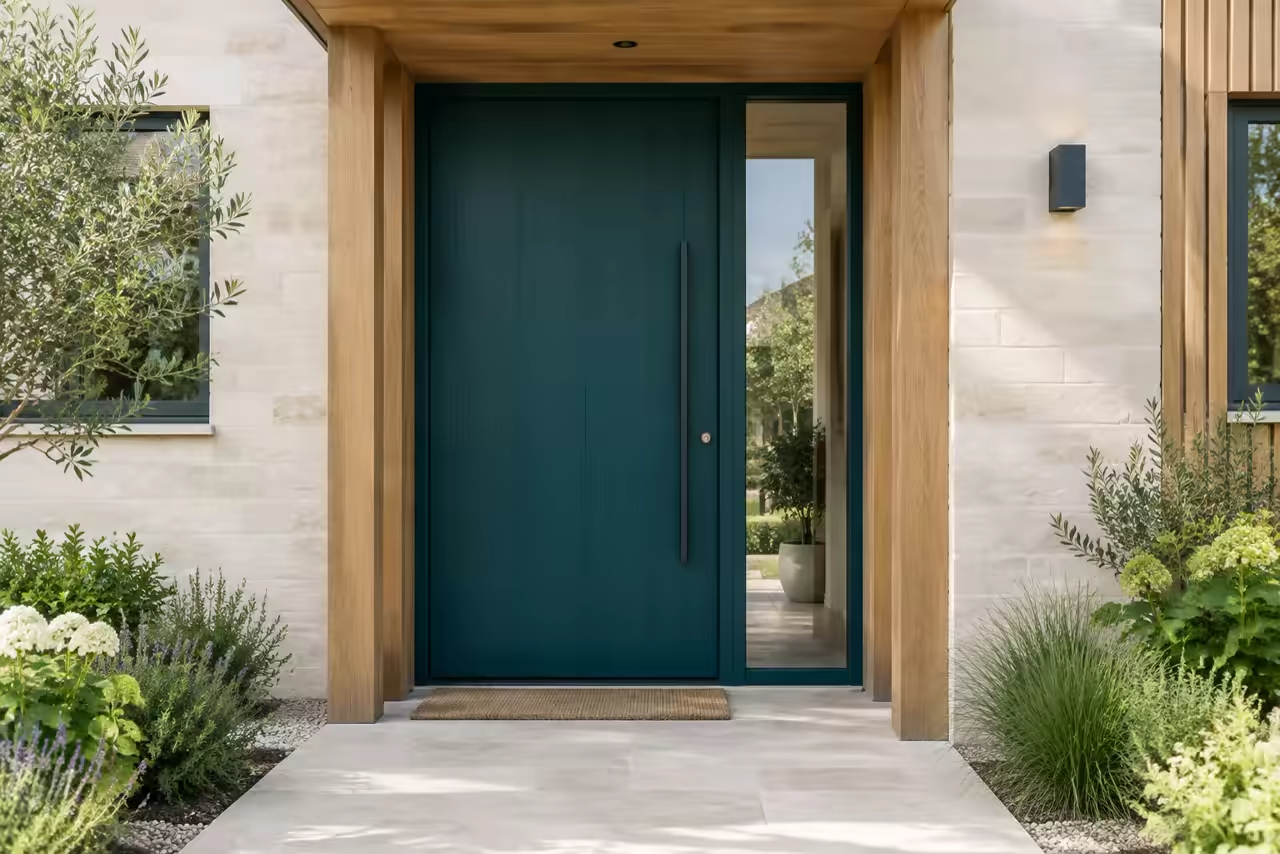
Popular composite shades include Anthracite Grey, Jet Black, Chartwell Green, Duck Egg Blue, Navy/Peacock Blue, Agate Grey and Cream — usually with crisp white inside unless you specify colour both sides.
Explore colours and finishes
Systems and brands
Well-known UK composite door manufacturers include Solidor, Endurance, Rockdoor, Comp Door and Distinction. Compare core construction, skin thickness (GRP vs thermoplastic), thermal-bowing tolerance and written hardware/finish guarantees in person.
Planning permission and building control
Standard front or back door replacements on unlisted homes outside conservation areas are usually in England; check conservation and listed-building rules before replacing historic timber doors.
permitted development
permitted development: Permitted development is a system of rights allowing certain work without a separate planning permission application, subject to conditions and limits. It does not remove building regulations or listed-building obligations. Rights differ between England and Scotland and can be restricted, so check the specific property and proposed work before relying on them. More on permitted developmentPlanning and rules tools
How composite doors are surveyed and fitted
Because composite doors are heavy, solid mechanical fixing into masonry behind all three hinges and the central lock keep — plus accurate hinge adjustment and weatherproofing under the — stops drooping and stiff locking.
threshold
threshold: A threshold is the bottom part of a door set that you cross when entering or leaving. It connects the door seals, drainage and floor levels. A low or visually flush threshold can make movement easier, but it still needs an appropriate weather detail and a properly planned external water route. More on thresholdSurvey and fitting guides
What a good quote must include
Check every composite door quote for these specifics:
Composite doors quote checklist
- Brand, core type (solid timber vs foam), leaf thickness (e.g. 44 mm vs 48 mm) and outer frame colour
- certification, TS007 3-star anti-snap cylinder and
PAS 24
PAS 24: PAS 24 is a security test specification for complete windows and external door sets. It examines resistance to defined attack methods rather than promising that a product cannot be broken into. Evidence should relate to the actual system, configuration and hardware, not merely a lock or a broad product range. More on PAS 24in glazed cassetteslaminated glass
laminated glass: Laminated glass has glass layers bonded around an interlayer that can hold broken pieces together. Depending on its specification, it may serve safety, security or acoustic purposes. Those functions are not automatic: the glass build-up, supporting frame and tested application decide what protection the complete assembly can provide. More on laminated glass - Written thermal-bowing policy (especially for dark south-facing doors) and hardware corrosion warranty (coastal sites)
- style (standard uPVC vs low aluminium), internal making good and old-door disposal
Threshold
threshold: A threshold is the bottom part of a door set that you cross when entering or leaving. It connects the door seals, drainage and floor levels. A low or visually flush threshold can make movement easier, but it still needs an appropriate weather detail and a properly planned external water route. More on threshold
Print this page to use the checklist on the day.
Red flags to watch out for
Be wary of these composite door red flags:
- Quoting 'composite door' without naming the manufacturer, core construction or cylinder rating.
- Selling a black or dark-blue composite door for an exposed south-facing wall with zero mention of sun-heat movement.
- Using cheap plated brass/chrome handles near the coast that pit and corrode within two winters.
- Leaving wide gaps around the frame packed only with expanding foam and thick plastic trim.
Questions to ask an installer
Ask installers quoting composite doors these five questions:
- Who manufactures the composite slab, is it solid timber core or foam core, and how thick is it?
- Is the complete door certified with a 3-star anti-snap cylinder and
PAS 24
PAS 24: PAS 24 is a security test specification for complete windows and external door sets. It examines resistance to defined attack methods rather than promising that a product cannot be broken into. Evidence should relate to the actual system, configuration and hardware, not merely a lock or a broad product range. More on PAS 24?laminated glass
laminated glass: Laminated glass has glass layers bonded around an interlayer that can hold broken pieces together. Depending on its specification, it may serve safety, security or acoustic purposes. Those functions are not automatic: the glass build-up, supporting frame and tested application decide what protection the complete assembly can provide. More on laminated glass - What is the manufacturer's thermal-bowing tolerance, and how do you handle adjustment if a dark door moves in summer?
- Is the external hardware marine-grade stainless steel if my entrance faces coastal weather?
- What separate guarantee lengths cover the door slab, paint/skin finish, glass unit and lock mechanism?
Choosing an installer
How it is surveyed and fitted: step by step
Compare solid-core vs foam-core samples
Feel leaf weight, inspect skin grain and glazing cassettes, and check outer frame colour matching.Check sun exposure and porch shelter
If your doorway faces full south/west sun with no canopy, check thermal stability for dark shades.Specify PAS 24, 3-star cylinder and laminated glass
Confirm full security testing, TS008 letterplate (or wall postbox) and whole-door Ud value.Survey aperture and floor clearance
Measure structural opening, internal floor/mat height and external step/drainage levels.Fix outer frame plumb and solid behind hinges
Pack frame tightly into masonry, sealon DPC and avoid foam-only fixing.threshold
threshold: A threshold is the bottom part of a door set that you cross when entering or leaving. It connects the door seals, drainage and floor levels. A low or visually flush threshold can make movement easier, but it still needs an appropriate weather detail and a properly planned external water route. More on thresholdAdjust hinges, test multi-point lock and file warranties
Verify effortless latch and deadbolt engagement, check weather compression and retain all guarantee documents.
Compare composite doors against the alternatives
| Compared | Composite front doors | Aluminium front doors | uPVC doors | Hinged front doors |
|---|---|---|---|---|
| Look and sightlines | Moulded skins in traditional and modern styles, often with woodgrainfoil (woodgrain): A woodgrain foil is a decorative surface layer bonded to a profile, commonly used on uPVC windows and doors to imitate painted or stained timber. It describes the finish, not the frame material. Texture, colour, corner joints and matching trims all affect how convincing the result looks on a real building. More on foil (woodgrain) | Flush, contemporary slabs with long bar handles; any colour inside and out. | Wider frames than aluminium; timber-look foilsfoil (woodgrain): A woodgrain foil is a decorative surface layer bonded to a profile, commonly used on uPVC windows and doors to imitate painted or stained timber. It describes the finish, not the frame material. Texture, colour, corner joints and matching trims all affect how convincing the result looks on a real building. More on foil (woodgrain) | The normal front door, in any style. |
| Maximum sizes | Maximum widths and heights for Composite front doors depend on wind load and glass weight — confirm against the maker's size chart. | Maximum widths and heights for Aluminium front doors depend on wind load and glass weight — confirm against the maker's size chart. | Maximum widths and heights for uPVC doors depend on wind load and glass weight — confirm against the maker's size chart. | Maximum widths and heights for Hinged front doors depend on wind load and glass weight — confirm against the maker's size chart. |
| Thermal performance | Must meet building regulations. England, replacement doors (60% glazed or less): maximum 1.4 W/m²K or band B. England, new homes: limiting 1.6 W/m²K (notional 1.0). Scotland: maximum 1.4 W/m²K. | Must meet building regulations. England, replacement doors (60% glazed or less): maximum 1.4 W/m²K or band B. England, new homes: limiting 1.6 W/m²K (notional 1.0). Scotland: maximum 1.4 W/m²K. | Must meet building regulations. England, replacement doors over 60% glazed: maximum 1.4 W/m²K or DSERDSER: DSER means Door Set Energy Rating. It assesses an external door set as a complete assembly rather than judging the door glass on its own. The rating takes account of energy performance, including heat loss and air leakage. Ask whether the label covers the exact leaf, frame and glazing proposed. More on DSERU-valueU-value: A U-value describes how readily heat passes through a building element. A lower value means less heat loss through that element. For windows and doors, distinguish the complete assembly from the glass alone: a good glass figure does not establish the performance of the frame, edges and finished product. More on U-value | Must meet building regulations. England, replacement doors (60% glazed or less): maximum 1.4 W/m²K or band B. England, new homes: limiting 1.6 W/m²K (notional 1.0). Scotland: maximum 1.4 W/m²K. |
| Security standard | Verify PAS 24PAS 24: PAS 24 is a security test specification for complete windows and external door sets. It examines resistance to defined attack methods rather than promising that a product cannot be broken into. Evidence should relate to the actual system, configuration and hardware, not merely a lock or a broad product range. More on PAS 24Secured by DesignSecured by Design: Secured by Design is a police security initiative that includes an approval scheme for products such as windows and doors. It is not a general guarantee against crime. Check the current listing for the proposed product and distinguish product approval from wider recommendations about the design of a building. More on Secured by Design | Verify PAS 24PAS 24: PAS 24 is a security test specification for complete windows and external door sets. It examines resistance to defined attack methods rather than promising that a product cannot be broken into. Evidence should relate to the actual system, configuration and hardware, not merely a lock or a broad product range. More on PAS 24Secured by DesignSecured by Design: Secured by Design is a police security initiative that includes an approval scheme for products such as windows and doors. It is not a general guarantee against crime. Check the current listing for the proposed product and distinguish product approval from wider recommendations about the design of a building. More on Secured by Design | Look for PAS 24PAS 24: PAS 24 is a security test specification for complete windows and external door sets. It examines resistance to defined attack methods rather than promising that a product cannot be broken into. Evidence should relate to the actual system, configuration and hardware, not merely a lock or a broad product range. More on PAS 24 | Widest choice of PAS 24PAS 24: PAS 24 is a security test specification for complete windows and external door sets. It examines resistance to defined attack methods rather than promising that a product cannot be broken into. Evidence should relate to the actual system, configuration and hardware, not merely a lock or a broad product range. More on PAS 24Secured by DesignSecured by Design: Secured by Design is a police security initiative that includes an approval scheme for products such as windows and doors. It is not a general guarantee against crime. Check the current listing for the proposed product and distinguish product approval from wider recommendations about the design of a building. More on Secured by Design |
| Ease of use | Solid feel; good weather sealing. | Stays true; feels solid and quiet. | Fine on smaller doors; large uPVC doors can drop or need adjusting. | Familiar; easy to fit closers and accessible thresholdsthreshold: A threshold is the bottom part of a door set that you cross when entering or leaving. It connects the door seals, drainage and floor levels. A low or visually flush threshold can make movement easier, but it still needs an appropriate weather detail and a properly planned external water route. More on threshold |
| Maintenance | Low; dark colours on sunny elevations need checking with the maker. | Very low; an occasional wash. | Wipe clean; hinges may need adjusting over the years. | Low. |
| Expected lifespan | Rockdoor and Solidor both publish 10-year composite door guarantees (Rockdoor: 10 years on sashsash: A sash is the framed part of a window that holds the glass; it often describes the moving part. In a sliding sash window, glazed sashes move vertically. The word alone does not identify the material, balance mechanism or cleaning action, so ask what the complete window description actually means. More on sash | Published UK aluminium door guarantees include up to 20 years on Origin products (location-dependent); confirm powder-coat and hardware terms separately. | Service life for uPVC doors depends on exposure, specification and care — ask for the written frame, finish and hardware warranties. | Service life for Hinged front doors depends on exposure, specification and care — ask for the written frame, finish and hardware warranties. |
| Typical price band | New front doors: typically £1,000 to £2,000, averaging around £1,500, with bespoke designs above £2,000 (MyBuilder front door guide, last updated 21 Aug 2026; checked 25 Nov 2026) (typical published UK range, supplied and fitted). | Front doors and frames overall: £500 to £3,000, average £1,750 (Checkatrade new door frame guide, last updated Sep 2026); higher-end or bespoke front doors can exceed £2,000 (MyBuilder front door guide, last updated 21 Aug 2026; checked 25 Nov 2026) (typical published UK range, supplied and fitted). | Standard uPVC external doors: £400 to £1,000+ (Checkatrade door installation guide, last updated Feb 2026; checked 25 Nov 2026) (typical published UK range, supplied and fitted). | New front door and frame: £500 to £3,000, average £1,750 (Checkatrade, last updated Sep 2026); typical range £1,000 to £2,000 (MyBuilder, last updated 21 Aug 2026; checked 25 Nov 2026) (typical published UK range, supplied and fitted). |
| Best for | Traditional and cottage-style front doors on a sensible budget. | Modern homes and statement entrances, including wide or tall doors. | Standard-sized back and side doors on a budget. | Almost every home. |
| Watch-outs | Quality varies widely; dark doors in full sun can move slightly. | Fewer traditional styles than composite. | Large panes and wide openings push uPVC towards its limits. | Very wide or tall slabs need heavy-duty hinges. |
Figures from published manufacturer data, building regulations and UK cost guides. Your price will depend on your project.
Prices are published guide figures from the sources listed, not our own quotes. Installed prices vary by UK region, access, glazing specification and making good.
- Pilkington UK — Part L England existing dwellings guidance (Part L 2021 (in force June 2022)) — checked
- REHAU — Part L existing dwellings fact sheet (PDF) (2022 edition) — checked
- British Woodworking Federation — Part L new dwellings summary (2022 Part L update) — checked
- Pilkington UK — Scottish Building Standards Section 6 domestic guidance (2022/2023 Scottish Technical Handbook) — checked
- Rockdoor — Composite door guarantee terms (undated manufacturer guarantee page) — checked
- Solidor — Care and 10-year guarantee guide (PDF) (undated manufacturer guide) — checked
- MyBuilder — New front door price guide (last updated 21 Aug 2026) — checked
- Origin Global — Up to 20-year guarantee page (undated manufacturer guarantee page) — checked
- Checkatrade — New door and frame cost guide (last updated Sep 2026) — checked
- Checkatrade — Door installation costs guide (last updated Feb 2026) — checked
Detailed side-by-side comparisons
The team's verdict
Composite doors are the UK's most popular front-door choice for good reason: they look right on cottages, Victorian terraces and modern semis alike, need no repainting and deliver solid thermal and security performance on a sensible budget. Just do not assume every composite door is equal — compare solid timber core vs foam core, check the outer frame reinforcement, ask plainly about dark-colour thermal bowing on sunny elevations, and insist on a 3-star anti-snap cylinder and certification.
PAS 24
PAS 24: PAS 24 is a security test specification for complete windows and external door sets. It examines resistance to defined attack methods rather than promising that a product cannot be broken into. Evidence should relate to the actual system, configuration and hardware, not merely a lock or a broad product range. More on PAS 24Everything we've answered about composite doors
Every comparison, answer, buying guide, fitting step, planning rule, system review, colour and glossary entry on this site covering composite doors (61 pages).
Comparisons (9)
- Aluminium vs composite front doors
- Pivot vs hinged front doors
- Bold front door colour vs matching the windows: which suits your home?
- Composite vs timber front doors: security, weatherproofing and cost
- Aluminium vs timber front doors: modern durability vs period character
- uPVC vs composite front doors: which is better value for a UK home?
- Aluminium vs uPVC front doors: is upgrading to aluminium worth the cost?
- Pivot door vs composite front door: statement entrance or practical all-rounder?
- Idealcombi vs thermally broken aluminium windows: Danish composite or all-metal?
Answers (10)
- Do I need safety glass in a door?
- What's the best front door for security?
- What does PAS 24 mean?
- What is Secured by Design?
- Are bifold doors easy to break into?
- What locks should a front door have?
- Do insurers care what doors and windows I have?
- Do I need a letterplate in a composite door?
- What's a multipoint lock and why does it matter?
- Can I have keyless entry on an aluminium door?
Buying guides (21)
- How to choose a front door
- Choosing handles, locks and hardware
- Security: how to make windows and doors harder to break into
- Looking after uPVC and composite
- Door locks and cylinders: what does anti-snap mean?
- Are smart locks and keyless entry worth it?
- Which security standards apply to windows and doors?
- How can you make existing doors more secure?
- How do you secure bifold and sliding doors?
- Front door security checklist
- Window security checklist
- How do you make windows and doors safer for children?
- What should pet owners know about glass doors?
- Which acoustic options suit road, rail and flight path noise?
- What should wheelchair users know about level thresholds?
- Which hardware is easiest to use with arthritis or limited grip?
- How do wider door openings help accessibility?
- Which finishes resist coastal corrosion?
- What are flood-resilient doors? (information only)
- How should you secure a holiday home or second home?
- How do you keep your home secure during an extension build?
Survey and fitting (3)
Planning and rules (1)
Glossary (17)
- What is a sightline?
- U-value: glazing glossary definition
- DSER: glazing glossary definition
- PAS 24: glazing glossary definition
- Secured by Design: glazing glossary definition
- toughened glass: glazing glossary definition
- laminated glass: glazing glossary definition
- threshold: glazing glossary definition
- lintel: glazing glossary definition
- lift-and-slide: glazing glossary definition
- thermal break: glazing glossary definition
- powder coating: glazing glossary definition
- RAL: glazing glossary definition
- dual colour: glazing glossary definition
- multipoint lock: glazing glossary definition
- building control: glazing glossary definition
- permitted development: glazing glossary definition
Questions people also ask
Is a solid timber core or foam core composite door better?
Solid timber cores feel heavier and offer dense screw retention for hardware; high-density foam cores can achieve very low and lighter hinge loads. Judge the complete door, thermal rating and warranty.
U-values
U-value: A U-value describes how readily heat passes through a building element. A lower value means less heat loss through that element. For windows and doors, distinguish the complete assembly from the glass alone: a good glass figure does not establish the performance of the frame, edges and finished product. More on U-valuePAS 24
PAS 24: PAS 24 is a security test specification for complete windows and external door sets. It examines resistance to defined attack methods rather than promising that a product cannot be broken into. Evidence should relate to the actual system, configuration and hardware, not merely a lock or a broad product range. More on PAS 24Why do some composite doors swell or stick in summer?
Dark outer skins absorb intense solar heat while the inside stays cool, causing slight temporary bowing (typically a few millimetres) until the door cools. A porch canopy, lighter colour or insulated aluminium door avoids this.
How secure are composite doors?
Well-specified composite doorsets achieve high attack resistance when tested to with multi-point hook locks, a 3-star cylinder and laminated door glass.
PAS 24
PAS 24: PAS 24 is a security test specification for complete windows and external door sets. It examines resistance to defined attack methods rather than promising that a product cannot be broken into. Evidence should relate to the actual system, configuration and hardware, not merely a lock or a broad product range. More on PAS 24Do composite doors fade in sunlight?
Quality UV-stabilised GRP and thermoplastic finishes resist fading well, though dark shades on exposed south walls weather faster — check the written colour-fastness guarantee.
Are composite doors worth it over uPVC doors?
For a main front entrance, yes — composite doors generally feel far more solid, look closer to painted timber and offer stronger insulation and styling than basic uPVC panel doors.
Can you get a composite stable door?
Yes — several UK composite makers produce split stable doors with interlocking on both upper and lower leaves.
multi-point locks
multipoint lock: A multipoint lock secures a door at several positions along the edge, using a linked mechanism operated by the handle or key. It can help engagement with the frame but does not guarantee security on its own. Cylinders, keeps, hinges, glazing and the tested door assembly all matter together. More on multipoint lockDo composite doors come in dual colour?
Yes — most UK buyers pick a colour outside and crisp white inside to keep the hallway bright.
What threshold options come with composite doors?
Standard rebated uPVC (best weather seal) or low aluminium mobility (easier step-over, best with sheltered porch or good external drainage).
thresholds
threshold: A threshold is the bottom part of a door set that you cross when entering or leaving. It connects the door seals, drainage and floor levels. A low or visually flush threshold can make movement easier, but it still needs an appropriate weather detail and a properly planned external water route. More on thresholdthresholds
threshold: A threshold is the bottom part of a door set that you cross when entering or leaving. It connects the door seals, drainage and floor levels. A low or visually flush threshold can make movement easier, but it still needs an appropriate weather detail and a properly planned external water route. More on thresholdCan you fit a cat flap in a composite door?
Cutting a hole through a composite door usually voids manufacturer thermal, structural and security warranties — check with the maker before ever cutting a slab.
How thick is a good composite door?
Most mainstream foam-core doors are around 44 mm thick, while solid timber-core slabs are commonly around 48 mm thick.
Can composite doors be fitted in an aluminium outer frame?
Most composite doors sit in steel-reinforced uPVC outer frames; a few specialist ranges offer aluminium outer frames.
Do composite doors need painting?
No — factory-finished skins only need wiping clean with warm soapy water.
Can I have a composite back door?
Yes — glazed or half-glazed composite doors make sturdy, secure kitchen and utility back doors.
What is a TS008 letterplate?
A tested security letterplate with an internal hood and restricted opening that stops intruders using hooks or rods to reach keys or internal thumbturns.
How do I clean a composite door without damaging the finish?
Use warm water, mild washing-up liquid and a soft cloth; avoid scouring creams, bleach, acetone or pressure washers.
Sources and editorial review
- ExpertSure — UK bifold door cost guide (prices verified Nov 2026 (20% VAT applies)) — checked
- GOV.UK — Approved Document L (Conservation of fuel and power, England) (2021 edition incorporating 2023 amendments) — checked
- Pilkington UK — Part L England existing dwellings U-value summary (Part L 2021 (in force June 2022)) — checked
- Scottish Government — Building standards technical handbook (domestic) (April 2026 edition) — checked
- GOV.UK — Approved Document Q (Security in dwellings) (2015 edition) — checked
- Secured by Design — Police Preferred Specification guidance (current SBD scheme guidance) — checked
- GOV.UK — Approved Document K (Protection from falling, collision and impact) (2013 edition) — checked
- GOV.UK — Planning permission in England and Wales (current GOV.UK guidance) — checked
Related
Ask a free question
Didn't find your answer? Ask the team. The team usually replies within one working day.